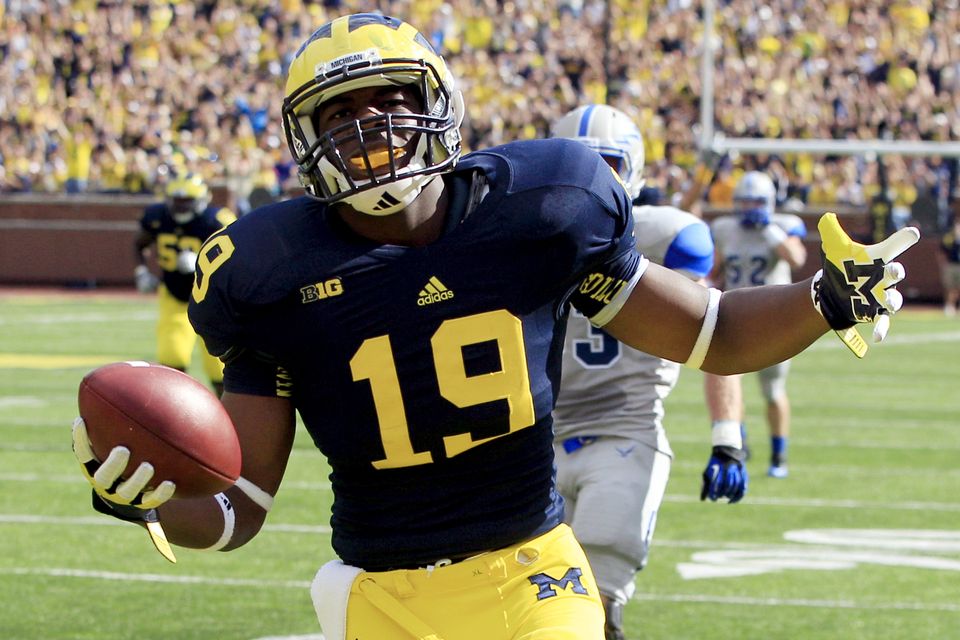
Showing posts with label Denard Robinson. Show all posts

Monday, October 8, 2012

Denard, Wolverines Stomp on Purdue, 44-13


Michigan made excellent use of their bye week as they came out healthy, motivated, and prepared to face a Purdue team that many expected (and still expect) to be the favorite for the Big Ten Leaders Division. Despite the disappointing and disheartening loss to Notre Dame two weeks ago, Michigan dispelled the negativity and proceeded to stomp on Purdue's throat, winning 44-13.

The Wolverines ran the ball a net 51 times for over 300 yards, and Denard Robinson only threw the ball 16 times, completing 8 attempts, but accumulating 105 yards in true Denard fashion. He was calm, collected, and made good decisions.

He also had the help of great receiver play from Devin Gardner, Devin Funchess, and Jeremy Gallon. Roy Roundtree even got a few catches in here--much to the dismay of Purdue fans. (Roundree had originally committed to Purdue before switching to Michigan.) Denard's performance allowed him to break the career rushing record for any quarterback in Big Ten history:

Robinson led the offensive attack with 235 yards on the ground to complement his 105 yards and one score through the air. With his effort on the ground, he set the Big Ten career quarterback rushing record with 3,905 yards, eclipsing the previous mark set by Indiana's Antwaan Randle El (3,895 yards, 1998-01).

You can watch highlights of the game here.

If there was one specific area that was lacking in Michigan's offensive play, it was the running game of Fitzgerald Toussaint, who ran over Purdue in 2011. Toussaint seemed hesitant whenever he got the ball and just didn't look like he trusted the offensive line.

The "stutter-step" that Toussaint is known for started to look like a negative feature when there were holes the offensive line gave him to run through, he sees a defender get a little bit around guard Patrick Omameh (although he is still blocked), and Toussaint bounces laterally with nowhere to go until three Purdue linebackers are in his face. Most of the rushing threat came from Denard, and eventually Thomas Rawls, who only ran over Purdue and scored an easy touchdown in garbage time, when the game was already decided.

The defense was also up to par, holding Purdue to 213 yards of offense and only 13 points, most of which were field goals. There is some debate about whether this was largely due to Michigan's more aggressive and more sound defensive performance, or the questionable quarterback play of Purdue's Caleb TerBush, who went 16 for 25 and threw what became a crippling interception that put Michigan up 21-0 in the first half.

Looking to improve from his horrible showing against Notre Dame, Denard threw no interceptions. The sole turnover given up from Michigan came on a botched hand-off to Vincent Smith, who in my opinion didn't fully secure the ball. However, with that being the only blemish in what was otherwise a fantastic game for Michigan in all three phases of the game, it's hard not to be happy with the Wolverines and optimistic about the future.

Brad over at Maize n' Blue Nation felt pretty good about Denard's performance in particular:

A 50% passing percentage for 100 yds and change with 1 TD and ZERO interceptions is fine with me. If we could get that sort of passing output from Shoelace each week, then I'd be thrilled. Of course adding 235 yards on the ground doesn't hurt either.

And the folks at Maize n' Brew were likewise pleased that Michigan came out strong and erased many doubts:

I predicted a close one, an ugly one, one that we would probably win but would not be memorable in any way. Of course, I was wrong, and I am very happy about that. Michigan dispensed the Boilers with ease, and everyone did exactly what they were supposed to do. Borges called Denard's number with regularity, Denard did what he does against teams not named Alabama, and the defense shut down a dysfunctional and limited offense.

I, too, was nervous entering this game. With all the talk from Northwestern, Purdue, and Minnesota fans that 2012 is their best opportunity to win the Big Ten with Ohio State and Penn State ineligible, Michigan and Michigan State sputtering through their non-conference schedules, and Wisconsin (who was once the perpetually presumed favorite) struggling to be what they once were, I was maybe starting to think that they were right.

As it turns out, while they may have been more successful in the non-conference, all those teams have since lost in the conference. Minnesota got whooped by Iowa, Northwestern blew a two-touchdown, fourth-quarter lead to give Penn State the victory, and Purdue just got their tails kicked by a few proud Michigan Wolverines. Suddenly it doesn't look like there was any reason to get so discouraged.

I am still concerned, however, about Michigan's chances of getting to Indianapolis. If they prepare for each game, they fully have the chance to do that, with the Big Ten being as weak as it is right now. However, as we have seen from the likes of Minnesota, Northwestern, Purdue, and even Nebraska (who lost to Ohio State depressingly 63-38), a few slip-ups can have disastrous results.

Michigan will have to play every game like they are the underdog and like they have something to prove. That's what they did against Purdue and it worked: with the sting of the Notre Dame loss still fully in their minds, the Wolverines came to West Lafayette with the intention to prove to themselves and everyone that they were contenders for the conference title. Running the table seems like a vain possibility, but if Michigan can be undefeated by the time they go to Columbus, they'll have secured the bid for Indianapolis.

That starts with taking care of business against Illinois, Michigan's homecoming game. The Illini are inconsistent and struggling as new coach Tim Beckman is trying to find something that can work and stick. Michigan State is an absolute must-win for Brady Hoke. The Spartans may have had their confidence shaken by the Buckeyes, but you can bet that no mistake that they made this season will show up when they come to Ann Arbor, where the Spartans attempt more than anywhere else to play a perfect game. And Nebraska, the away game that most pegged as a sure Michigan loss, is not invincible.

After that, Michigan plays Minnesota, Northwestern, Iowa, and the hated Buckeyes to close out their November stretch--a rare instance where the month of October (Illinois, MSU, Nebraska) is tougher than November (except for the last game). If Michigan can successfully survive through the grinder of October, there won't be many doubters left.

Saturday, September 22, 2012

Turnovers, Penalties Kill Wolverines against Irish


Michigan was hit by the turnover bug big time.

Denard Robinson threw four interceptions. Yeah, that's right, four. And if you think that's too much, he threw those four interceptions in the first half alone. There were five turnovers (all interceptions) in the first half, as Vincent Smith also threw an interception on what was supposed to be a red zone trick play.

There were six turnovers (you will read that term a lot more in this article) in all. Michigan obviously limited turnovers significantly in the second half, with the only other turnover being a Denard fumble. Michigan lost to Notre Dame 13-6, and if there was one crystal clear reason why, that was it. You simply cannot win a game when you turn the ball over six times.

Although Denard has been Notre Dame's nemesis for the past three years, that clearly wasn't the case this time. The turnovers completely overshadowed Denard passing Chad Henne in accumulating total yards.

The hero for Notre Dame? Definitely Manti Te'o. The All-American linebacker picked off two of the interceptions Denard threw and was largely responsible for limiting him on the ground. On crucial third down runs, it was usually Te'o who made the stop.

It might be hard to process this, but Michigan's defense actually played pretty well. They limited the Irish to under 200 yards and got two turnovers of their own, forcing Notre Dame coach Brian Kelly to bench redshirt freshman quarterback Everett Golson (who many believed would be the difference maker in this game) for veteran quarterback Tommy Rees. Ironically, it was Rees who scored the only touchdown for the Irish, on a goal line quarterback sneak into the endzone.

Michigan holding Notre Dame to 13 points doesn't mean much when you only put up two field goals. At the end of the day, the only thing that matters is the final score. There will doubtlessly be tons of angry Michigan fans who put all of the blame on offensive coordinator Al Borges for the playcalling. 

Was there bad playcalling? Sure. The would-be trick play by Vincent Smith which turned out to be an interception is certainly worth criticism. It's the type of play, however, that gets you a big pat on the back when it works and a big smack upside the head when it doesn't. I don't fault Borges too much for that.

Nor do I fault the offensive line, which I was worried about most going into this game. They looked surprisingly good and gave Denard all day to throw. The defensive line, too, performed moderately well against the run, up until the fourth quarter, when Notre Dame had all the momentum.

But really, the thing that killed Michigan most was the turnovers. Denard was shredding Notre Dame on his first couple of drives, moving the ball down the field by finding Devin Gardner. One interception quickly became three as Denard threw one on each of his next three passes, killing three straight drives.

I mean, what do you do going into the second half? Do you bench Denard and simply bring in a new quarterback (Bellomy or Gardner)? Or do you just run the football and never pass again? It's a tough call. I don't think you can bench Denard because he's too dangerous with his feet. The running game was sporadic at best, and you can't become predictable when the game is as close as it was.

That's another thing that needs to be considered. It's not like the game was a blowout loss. Michigan, especially their defense, stuck with Notre Dame the entire game. The only time Notre Dame even scored a touchdown was off an interception that Denard threw, putting them inside Michigan's 40. They never crossed the fifty and scored a touchdown on the same drive.

It's tough going forward. The Notre Dame game has so often been a measuring stick for where Michigan is as a program year in and year out. The Alabama game showed us that we're not ready to compete for national championships yet.

What has the Notre Dame game shown us? Our defense can make plays. They can stop the run. Our offensive line can give the quarterback plenty of time to pass. And perhaps most obviously, our quarterback needs work. Denard really needs to adjust his decision-making if we're to have a successful season.

For years I've been wondering when Notre Dame is finally going to break the losing streak against Michigan, and this year, it happened. When a rivalry starts to get lopsided, it puts more pressure on the other team to turn the tide. There was no way Notre Dame was going to overlook this game. Hats off to them, because they made great takeaways when they needed to and capitalized on Michigan's mistakes.

Michigan opens up Big Ten play against Purdue in West Lafayette. The run for the Big Ten championship is still wide open as far as I'm concerned. The only undefeated teams remaining in the Big Ten are Northwestern, Minnesota, and Ohio State, all at 4-0. That's less of a credit to their teams' play and more a credit to their teams' soft non-conference schedules.

Although we lost to Notre Dame (which wasn't completely unexpected), there are two more rivalry games left to play. And Michigan State and Ohio State both look very winnable.

Sunday, September 16, 2012

Michigan's Defense Shuts Out UMass in Second Half, While Offense puts up 63 Points


I really have to temper my expectations with this team.

I was hoping to start this recap with the opening line, "Now that's more like it," anticipating that Michigan would hold UMass scoreless--or at least no more than what Indiana allowed: 7 points. I was willing to forgive a single touchdown. It happens. You're playing backups and freshmen in "garbage time," and the over-matched opponent sneaks one by you. You hope to pitch the shutout, but it doesn't always happen.

UMass scored better against Michigan than they did against Indiana--13 points. The sole touchdown was a pick-six from another Denard interception--Are we really surprised by this anymore?--the other six points were two field goals.

You could argue that Michigan's defense didn't allow the Minutemen to score a single touchdown, in either half, so that's something of a victory. You could argue that Michigan utterly shredded the Minutemen on offense, easily covering the spread, and eight different players each scored a touchdown. You could argue that, despite the mistakes in the first half (the Denard interception, allowing UMass in field goal range twice), the defense didn't allow a single point in the second half, and neither Denard nor the offense turned the ball over again. So adjustments were made.

More importantly, you could argue that Michigan won and it shouldn't really matter how they did it--especially when they covered the spread.

You could also argue that the first half was an utter embarrassment. An 0-2 UMass team that could barely stay above water against Indiana and only scored a touchdown when the Hoosiers were tired and complacent came in to Michigan's house and put up almost twice as many points as they did against what could be the worst team in the Big Ten--the Hoosiers just lost to Ball State 41-39.

I was absolutely livid at the end of the first half. I have learned that I do not watch Michigan football well when I have even the slightest amount of optimism about the season. 2010: hopes and dreams crushed. 2011: expecting 6-6 but hoping for 8-4, instead getting 11-2. 2012: expecting 9-3 with Big Ten title, getting two victories that were far closer than I believed they should have been. This might be the understatement of the month, but Michigan is not representing the Big Ten well.

People love it when Denard runs. I don't. I watched this game in a Michigan bar and everyone cheered madly when Denard took off on a scramble for a touchdown, while I'm the only person screaming "No! Run Fitz! You don't need to run Denard against UMass!"

And, of course, everyone looks at me like I'm crazy.

Don't get me wrong: I love Denard's ability to make plays with his feet. He is truly one of the most explosive players in college football today. But I absolutely hate it that he's the staple of our offense, that he racks up more yards than everyone else combined, because to me this means that without Denard our offense would be terribly inept. The last thing I want to see is Denard tear his ACL on a big run against UMass. What a waste.

Thankfully, that didn't happen, and hopefully, it won't. But I have that fear in the back of my mind--no, the front of my mind--whenever he takes off running. Why in God's name is Michigan not running Fitzgerald Toussaint? Last time I checked he racked up over 1,000 yards last year.

Denard should only take off on big runs when he absolutely has to, when there are no receivers open and when there's a wide open space on the field--hopefully by the sideline, so he can step out and not get touched. I must sound terribly pessimistic. Michigan has two healthy 1,000-yard rushers on the roster, and only one of them is getting over 100 rushing yards a game. On any other team that would be the running back.

Toussaint actually got a few more carries and had a great game, but I watched in frustration as Michigan continued to throw the ball and run Denard when they could have easily run the ball down UMass's throat A-Train style with Fitz. Am I missing something here? So, a national championship is no longer possible, but the coaches are attempting a Heisman campaign? Not happening. Name one Heisman quarterback that threw 13 interceptions. At this rate, that's at least how many Denard will have by December.

I think the problem is more with me and less with Michigan. The Wolverines were pretty much at this level last year--making a ton of mistakes, needing to improve on all fronts--and because I didn't expect much out of them, it was pretty easy to keep a level head. I have to see this season at Michigan's attempt at "2011 2.0" instead of "2012: the Next Step."

If you remember, the 2011 Michigan squad was hardly a dominant football team throughout most of September. They were decent but gave up yards and a couple big plays to Western Michigan before thunderstorms ended the match prematurely. They eked out a close one to Notre Dame. They shut down and slapped around Eastern Michigan while still having a few "facepalm" moments. By the time they faced Minnesota, Illinois, and Nebraska, they were much better than when they played Notre Dame. They had improved.

My mistake was assuming that they wouldn't regress at all. I knew and expected that the Alabama game was going to be rough and painful, but I thought that Air Force and UMass would be cake walks compared to the Crimson Tide. That Michigan has struggled against these significantly less-talented teams means either that the Wolverines are just not that good and 2011 was largely a fluke, or they were so beaten up by Alabama that they are still recovering. Neither one is good for Michigan's season.

I had significantly relaxed by the second half. And it wasn't a "Resignation to Mediocrity" type of relaxing either. It was good to see that Michigan made adjustments, shut out the Minutemen entirely, and managed to dominate on offense with backups and freshmen and Denard watching elatedly from the sidelines.

It was nice to see that other players got to bask in the spotlight for a bit. They wouldn't come anywhere near close to what Denard had done, but what can you do. Justice Hayes, one of the most overlooked Michigan running backs (largely because he seems better suited to Rodriguez's spread), scored a late touchdown with ease at the goal line thanks to Michigan's second string offensive line, composed primarily of walk-ons and true freshmen. That was against UMass's first string. The blowout had gotten to them.

I don't really know what to expect from Michigan this year anymore. In 2010 I let myself believe too strongly that we would win at least ten games. We staggered our way to seven, and in all of the losses the games weren't even close. In 2011 all I wanted to see was improvement. We stumbled sometimes but improved every week and surprised a few people. I seem to be back to that mode of thought from 2010, thinking "We should be good" instead of simply "We could be good."

I have no idea what the future holds. I have no idea if Michigan will go 9-3 or 7-5. The Big Ten conference is doing abysmally. Michigan is 2-1 but they don't exactly inspire confidence when you think about how they'll do against rivals like Notre Dame, Michigan State, or Ohio State. And then you look at Notre Dame, Michigan State, and Ohio State, and they don't exactly inspire confidence either.

The Irish shut down Michigan State on the road but squeaked by Purdue at home. For all their talk of a steamrolling rushing attack, the Spartans sure didn't have one against Notre Dame in a prime time matchup with a home crowd to support them, as they failed to score a single touchdown on their home turf for the first time since 2006. Finally, the Buckeyes look amazing when the opponent doesn't fight back. When the opponent does (as Cal, a 5-7 team in 2011, did), they don't look so amazing. I wonder how they'd fare against Nick Saban.

A small part of me thinks that we will not defeat any of those three teams this year. Another part thinks that Michigan will improve enough to pull it off and win at least two. I mean, why not? Part of being a college football fan means realizing that anything can happen. USC, the team everyone picked to produce a Heisman trophy winner and a BCS championship matchup with Alabama, just lost to a Luck-less Stanford. College football is crazy and unpredictable sometimes.

And so is being a Michigan football fan.

Sunday, September 9, 2012

Wolverines Survive Fourth Quarter Meltdown against Air Force


Michigan successfully bounced back when they desperately needed to do so, improving to 1-1 after defeating the Air Force Falcons 31-25 in the Big House.

The Falcons, to their credit, made this a much closer game than it should have been. The triple-option offense is clearly difficult to defend and caused as much anxiety for the defensive coaches as it did the Michigan fans watching the game. So, I really don't know what to think of Michigan right now.

The defense as a whole looked decidedly mediocre, having what can only be described as a meltdown at the start of the fourth quarter (more on this later), but if the triple-option is really as migraine-inducing as defensive coaches claim it to be, then maybe we can forgive the defense a little.

Here are some game notes:

  • Thank God there are no more numbers on the helmets. This was probably my biggest "harumph" type of complaint last year when Michigan decided to keep numbers on the helmets from the Minnesota game on through the Big Ten schedule. Needless to say I am thrilled that the numbers are gone. The greatest helmet in college football has returned to its pristine glory.
     
  • Who says tight end was a weakness of Michigan's offense? The Wolverines didn't look like they missed Kevin Koger too much as Farmington Hills Harrison standout Devin Funchess (pictured) stepped up in a big way. Funchess (6'5", 229 lbs.) caught four balls for 106 yards and a touchdown. (Fun fact: Farmington Hills Harrison is traditionally a Spartan pipeline.)
     
  • Denard Robinson actually had a pretty good day passing, going 17 for 25, throwing for two touchdowns. He maybe threw two bad passes the entire game, and one of them ended up being picked off (the pass that was too high for Vincent Smith). In usual Denard fashion, Shoelace was electrifying on the ground, harkening back to the 2010 Rodriguez days.
     
  • Where in the world was Fitzgerald Toussaint? The feature running back who served his one-game suspension during the 41-14 rout from Alabama had a sparse 8 carries for 7 yards (ouch). Denard took much (or all) of the load, with 20 carries for a net 218 yards. I don't understand this. The whole point of getting Fitz back was so he could take some of the pressure off Denard. It really should have been him who got the 20 carries.
     
  • Elliot Mealer seems to be doing well at center. His shotgun snaps were crisp and right on the money. There was of course that one bobbled snap, but one bad snap amid 50 is acceptable. I was seriously worried that whoever was at center (it was looking like Ricky Barnum for a while there) would have serious trouble getting the snaps off a la Rocko Khoury in the first drive of the Sugar Bowl. For now, that doesn't look to be the case, which is good.
     
  • Overall I felt the offense was pretty efficient. Denard's big runs aside (still wished there was more Toussaint), the emergence of Devin Funchess and Devin Gardner as big targets have added a new dimension to this offense. Couple this with the fact that both Funchess and Gardner are in their first years at the positions and you're looking at some lethal threats down the road and next year. Seriously, those guys are dangerous.
     
  • The Meltdown: Michigan gave up several third-down conversations and a fourth-down conversion at the start of the fourth quarter, as well as a touchdown. That touchdown should have never happened. I fully expected Air Force to score a minimum of 10 points, and a maximum of 17, but 25? Michigan had been seeing the option attack all game and by the fourth quarter should have at least made some adjustments to counter it. The huge give-ups on third down, fourth down, and the 2-point conversion were almost certainly the low points of the game.
     
  • Contrastingly, it was Michigan's defense which effectively sealed the win on the crucial third and fourth down stops on Air Force's final two drives. Jake Ryan was responsible for giving up two touchdowns, but also was the one who batted down Air Force quarterback Connor Dietz's would-be pass on fourth down to seal the victory.
     
  • I am legitimately concerned about this defense. I am equally concerned about Michigan's chances at making a run for the Big Ten championship. Right now, it's not looking too good. As several Michigan blogs have already noted, a lot of this could simply be that Air Force's option attack is just so tough to defend that we can't tell if Michigan's defense has really gotten any worse or has just played two really tough games (defensively) to start the season.

I watched this game twice (once Live and once on Replay), and while I did feel a little better about the team on the second time around, that fourth quarter was still a nail-biter. A win is a win, but 31-25 felt like a little too close for comfort. As I said previously, this could all be because Air Force is "just one of those teams" that you can't 100% prepare for -- but still, I feel a little uneasy about the Big Ten conference play. Obviously, Michigan didn't exactly start out great in 2011 either. The hope now is that they improve week-to-week just like they did last season. We'll have more definitive estimates once Michigan plays Notre Dame and Michigan State.

Michigan goes on to face Massachusetts at home in what looks like the only cupcake of the schedule, which means that it will be the best chance for the Wolverines to fine tune their gameplan. After that is an early season showdown against Notre Dame in South Bend, followed by the conference opener against Purdue. After thrashing Navy 50-10, the Fighting Irish just squeaked by their game against the Boilermakers, 20-17.

Tuesday, September 4, 2012

Borges: Offense "Still a Work in Progress"


If there's one thing that's good about losing a single game, it's that it produces a lot of drama. And drama breeds more writing material.

Recently there's been a lot of criticism levied against Michigan offensive coordinator Al Borges for sticking with a seemingly ineffective game plan regarding Michigan's 41-14 loss to No. 2-ranked Alabama.

This is largely an argument in his defense.

In Borges's Tuesday press conference--which you can watch here--the first question he was asked was whether or not he would go back and change his game plan. Borges's answer:

Very little would I change. Very little. Almost none. That’s probably hard to grasp because of the way we executed. The game plan didn’t look very effective, but the whole thing was geared to if they loaded the box up, we were going to throw the ball, and if they left the box light, we were going to run it. We ran the ball into a light box twelve times and had +4 runs three times out of the twelve. And we hit two out of ten shots down the field. So, the other alternative is to +1 run with the quarterback. We did some of that, too, but they weren’t going to let you do that. As much as you wanted to give that a shot, that wasn’t going to happen. No one’s done that to them. Look at the numbers in the past. No one’s done that to them.

The question is telling. There seems to be this notion that if we only ran Denard twenty or thirty times, we would have won the game or somehow at least have kept it close.

We can see this criticism best summed up by the post-game reaction by Brian Cook at mgoblog:

At no point did Al Borges deploy the EMP weapon he must have spent the offseason perfecting in lieu of figuring out what Denard Robinson is good at.
...
At halftime I bellowed "THAT'S BECAUSE YOU'RE NOT RUNNING DENAAAAARD" at the television.
...
Any hopes you may be harboring that this will all work itself out and Denard's legs will be the primary engine of the offense are looking pretty sickly at the moment. At least we've been here before, and Borges has retreated to plot anew. Usually he comes back with "hey, this guy can run."
...
The only rationale I can think of that makes any sense is that Borges believed flat-out that Michigan could not run at all and wanted an offense predicated on that.
...
If Robinson has 30 carries against Air Force I'll again descend into the Walter White [of AMC's Breaking Bad] laugh.

The criticism seems to be based on the precepts that 1) Denard Robinson is the most explosive player in Michigan's offense, 2) Al Borges must run Denard in order to win games, and 3) putting Denard in a spread offense would result in more success. The third one really comes through here:

Would have been nice to see what Robinson could have become in an offense that catered to—or even bothered to use—his primary skill.

I think there is a fundamental misunderstanding to the state of our team by some of our fans. Although it was continually lost on Herbstreit and Musberger during the broadcast, the decision by Al Borges to run Denard infrequently was borne more out of necessity than preference.

Denard may very well run the ball twenty times in other games. It wasn't an option against Alabama, as Borges points out:

We’ll play that game by game, but I would not have run Denard Robinson any more than we ran him on Saturday. Absolutely not. No, I know a lot of people think that, but no way. That wasn’t going to happen. But in certain games you’ll run the ball. I mean, it’s just like last year. You’ll see certain games he’ll carry it 25 times. You’ll see other games he’ll carry it 10 to 15 times. You can run him 20 times every game, you'll get nothing left of him by the end of the season, particularly when you’re playing opponents like [Alabama]. That’s already been proven.
...
In the Alabama game they weren’t going to let you run. Look at their numbers, guys. They’ve never allowed a quarterback to run the football. Not with any significance. They play a front, they play a defense that forces the quarterback to throw the ball. You can run here and there, but if you think you’re going out of there for 150 yards, it’s not going to happen all the time. But in other games -- there will be certain games you’ll see him run a lot more.

What needs to be understood is two things. The first is that the last thing you want is to injure your starting quarterback in the first game of the season when you have 11 more games to play. History says that running Denard twenty to thirty times does not necessarily guarantee success (see 2010 Ohio State, Mississippi State, etc.), and more often than not it means that Denard will not finish the game (see 2010 Bowling Green, Illinois).

Even in an offense that seemingly suited Denard’s skills, there was a greater fear that he’d be injured out of the game instead of throwing an incomplete pass. I’d rather have the latter.


The second thing that needs to be understood was obvious to anyone who watched the game—or at least, it should be obvious to anyone who watched the game: Alabama was not going to let Denard run.

They knew coming in that he was Michigan’s most explosive player and they would be watching him at all times. Given Saban’s aggressive defense, the way that Alabama likely intended to stop Denard Robinson was by knocking his lights out.

So, not only is it imprudent to run Denard thirty times when that’s exactly what the opposing defense is looking for, it’s also exhibits a lack of understanding the opponent’s primary strength in defending the run. It’s not like we were playing Connecticut.

Borges knew that going in. Contrary to the narrative ESPN was pushing in an attempt to hype up the game, Denard was not an "X-Factor" for which Saban's defense would have no answer. And Borges is right: if you look at the stats, dual threat quarterbacks had virtually no success running the ball against Alabama.

Here are a few examples: (links to box scores included)

In Alabama's 2011 regular game against Ole Miss, dual-threat quarterback Randall Mackey had 12 carries for 6 yards.
...
In Alabama's 2011 regular season game against LSU, dual-threat quarterback Jordan Jefferson had 11 carries for 43 yards.
...
In the 2012 BCS national championship game, Jordan Jefferson had 14 carries for 15 yards.

Those are two SEC quarterbacks who each didn't manage 100 yards. History does not support the notion that Denard Robinson would have fared any better against the Crimson Tide.

So what was the alternative?

Michigan blog Touch the Banner summed up Borges's challenge nicely:

Michigan wasn't going to be able to run the ball in this game. I predicted that Michigan would rush for fewer than 100 yards; the final tally was 69, despite having one of the most electrifying players in the country at quarterback. Yes, Denard Robinson probably could have run the ball more, especially before he got dinged up. Would it have made much of a difference? Probably not. Where Robinson really could have made a difference was in the passing game.

Exactly. The passing game. If Alabama had any type of weakness (and that's stretching the term a bit), it would be in their inexperienced secondary. Borges's plan to throw the ball when they stacked the box is exactly what you'd want to do to put pressure on those defensive backs. In fact, that's really the only thing you can do.

Maize n Brew's Anthony Mammel took a sort of critical approach with this:

What in the world was Michigan running the ball on first and second down for? Vincent Smith and Thomas Rawls combined for 19 carries and 42 yards! To any other coordinator this means the running game should only be used just enough to keep a defense honest, especially when Alabama is bringing back side edge blitzes like it's the last game they'll ever play. The opportunity for Robinson to take advantage was clear, yet Borges just had to keep on truckin'. Don't do this against Michigan State again.

And later, in the comments:

He [Borges] was calling running plays that were averaging no more than two yards the entire game while Alabama continued to bring the heat. No excuse for that, especially late in the game when we needed points in a hurry.

This is kind of missing the point. One, Michigan's receivers didn't catch all the deep balls thrown their way, which would have forced Alabama to adjust and likely would have changed the entire landscape of the game. Second, Borges had to take some of the pressure off Denard's passing woes by running the ball (with a zone read) when the box was light (i.e. dropped back into coverage).

On many of those reads, Denard chose not to keep the ball. While some believe that Denard keeping the ball would have meant a greater chance of success, the only difference that I think would have happened would be that we'd be now trading sentiments of "Get well soon, Denard" and talking about the season going forward with Russell Bellomy or Devin Gardner as our quarterback.

Yes, Michigan needed points in a hurry, but they weren't making gains on the ground or in the air. In fact, the only two opportunities Michigan had to score came off two deep balls thrown that were actually caught (one by Jeremy Gallon which put Michigan at the one-yard line, and the other by Devin Gardner for a touchdown). Michigan's running game played virtually no part in getting them down the field, and what sucks is that they couldn't even if they wanted to.

Adding Denard Robinson's legs to the mix would have been worse for Michigan than for Alabama. There were a lot of reasons why Michigan lost this game, not the least of which is that Alabama is really, really good. But the game wasn't lost because Al Borges made the correct decision to attack Alabama where they were "weakest" (again, stretching the term) and that was against their secondary.

The biggest thing that we have to understand from this game is that Michigan's offense is, as Borges notes in the press conference, still a work in progress. While Denard is not Borges's prototypical passer, Borges is still working with him, and he is getting better. Against teams that aren't the defending national champions, we should see a noticeable difference.

The other thing that shocks me is how people forget we are still in the process of transitioning to a new offensive system (though, again, utilizing what we have, making decisions based on the situation at hand) and are still recovering from the worst period in Michigan football history. Remember that Michigan has lost worse games than to No. 2-ranked Alabama. I mean, it's like the No. 8 ranking warped everyone's minds and made them think Michigan was somehow a dark horse contender for the national title. No, we still have a long way to go.

"It's the first game, tough opponent," Borges said. "Our kids are resilient, and we've got some good leaders on this team. It's a tough way to start -- for all of us, for the coaches, for the players -- but you've got 11 games. If I'm not mistaken, Oregon played LSU last year. Wasn't it the same game [as ours, Cowboys Classic]? What was the score of that game? It wasn't even close. How did Oregon do ... after the game? I think they won 11 games. So, it's not [lost]. You don't chuck it all. You've got to be resilient. You've got to get back to the basics."

Monday, August 27, 2012

Denard Robinson and Jordan Kovacs Named 2012 Team Captains


The University of Michigan athletic department announced yesterday that senior quarterback Denard Robinson and senior safety Jordan Kovacs were voted captains by the Michigan football team. Denard will represent the offense and Kovacs will represent the defense.

Via the U-M press release:

"Denard and Jordan are two guys who represent what Michigan football stands for, on and off the field, and they certainly are deserving of being named team captains," said Hoke. "They have played a lot of football here. I know they will do a great job of leading the seniors and Team 133."

Kovacs, a three-year letterman and starter at safety, has opened 33 of 37 career games. He has totaled 266 tackles -- 21 for losses -- five sacks, four interceptions, two forced fumbles and three pass breakups in his career. Kovacs was named to the 2012 preseason watch list for the Bronko Nagurski Trophy and Lott IMPACT Trophy.

A three-year letterman, Robinson has started 27 of 38 career games in three seasons at Michigan. He has completed 338 of 580 passes for 4,931 yards and 40 touchdowns and rushed 546 times for 3,229 yards and 35 touchdowns. He ranks in the top 10 in U-M history in passing completions, attempts, yards and touchdowns and in rushing yards, touchdowns and 100-yard games (14). Robinson was named to the 2012 preseason watch list for the Davey O'Brien Trophy and the Manning, Maxwell and Walter Camp Player of the Year Awards.

Michigan (Team 133) is fulfilling a time-honored Michigan tradition where the players elect the captains, and typically there are two. (There have been exceptions, however. Former running back Mike Hart noted that during his final year, there were three captains. Additionally, during the 2011 season, Michigan had three captains in center David Molk, defensive tackle Mike Martin, and tight end Kevin Koger, with defensive end Ryan Van Bergen as an honorary fourth.) The elevation of Denard Robinson and Jordan Kovacs to captain is particularly interesting because the two represent great individual underdog stories of how they got to Michigan.

Denard Robinson was originally a four-star rated defensive back (unrated as a quarterback) from Deerfield Beach, Florida. Despite several offers to play defensive back, Denard wanted to play quarterback. He chose Michigan because Rich Rodriguez offered him that chance. In two years Denard beat out presumed starter Tate Forcier for the job and subsequently set out to light up the college football world. When Brady Hoke arrived in January 2011, there was some talk about Denard possibly transferring, but this turned out to be a canard.

Ever the Michigan Man, Denard affirmed his commitment to stay. All he wanted was the chance to play quarterback. It's doubtful anyone else would have offered him that chance. Denard had already carved out a place for himself as Michigan's quarterback, and leaving the program would mean that he would have to start over. To his credit, Brady Hoke was confident in Denard's ability to play the position and lead the team. "I can tell you one thing," Hoke said in his opening press conference. "We've got a special player in Denard."

Hoke and his offensive coordinator, Al Borges, successfully adapted their scheme to fit Denard's skill set (as opposed to the other way around, a.k.a. "putting a square peg in a round hole") while still at the same time gradually incorporating elements the pro-style offense that they hope to install by the time Denard graduates. As a result, Denard's production didn't exactly drop off and the offense was still very productive, with Denard throwing 2,173 yards and rushing for 1,176 yards, 20 passing touchdowns, and 16 rushing touchdowns.

The Wolverine's 2012 Michigan football preview issue makes an important note:

[Denard Robinson] is a special player, unlike any other in Michigan football history. Robinson has his faults--he was the only quarterback in the nation to throw 12 or more interceptions (15) with fewer than 260 passing attempts (258) last year--but Wolverine Nation loves him just the same.

This is true. We certainly do.

Jordan Kovacs has gained similar infamy in recent Michigan football lore. He is a former walk-on from Curtice, Ohio, who came aboard during the worst struggles of the Michigan defense during the 2009 season under Rich Rodriguez. Kovacs had to walk-on twice (2009 and 2010) before he was eventually offered a scholarship by Hoke's staff in 2011. He has since become Michigan most consistent player on defense.

Defensive coordinator Greg Mattison raved about Kovacs in a recent press conference, which is rare for someone as experienced and reserved as Mattison. "There's one that's consistent," he said. "And that's No. 32. That young man has had a tremendous camp. I mean, you talk about consistency, if you graded every play, I would like to see that great [every time]. . . There's a number of them that have been very consistent for a practice, and then they have to come back to the next one. So, I don't want to name names because I wouldn't be doing them justice as far as who's had this practice or hasn't, but that's one I will name. I'll name Jordan Kovacs. He just gets better and better. He's what it's all about."

Kovacs had long been considered one of the primary leaders (if not the leader) on defense, so it should come as virtually no surprise to anyone that he was named one of the team captains along with Denard Robinson. Frankly, I'd have been surprised if someone other than Jordan Kovacs had been named captain.

He now joins the ranks of famous Michigan players who started out as walk-ons and subsequently became captains, players like offensive tackle Jon Jansen, who helped lead Michigan to a national championship in 1997. During the Big Ten Network's visit to Michigan as part of their 2012 football preview tour, Kovacs had a chance to reflect on his journey from walk-on to starter to staple of the defense.

"It was tough," he said. "It was quite the roller coaster ride of emotions, to be unrecruited by really any school and to have to make two student-body tryouts. And then things just fell into place, and to be where I am today, it's not exactly what I was expecting, but I wouldn't want it any other way. I think those struggles are what made me the ballplayer that I am today, and I'm proud of that."

Kovacs and Denard Robinson will lead Michigan into the season opener against Alabama, the defending national champion, in what looks to be one of the most anticipated first games in Michigan football history.

The future, now, is in their hands. They are the captains of Team 133.

Sunday, August 19, 2012

2012 Seniors Must Make the Most Out of Their Final Season


It's an age old story. We hear it over and over again. Though this time, it somehow feels different.

That's because it is. Expectations are high. Brady Hoke will tell you they always have been, but let's be realistic. No one outside of the Michigan coaching staff expected the Wolverines to go 11-2 and win the Sugar Bowl, not after the epic failure of the Rich Rodriguez years where the Maize and Blue won 3, 5, and 7 games in three years, respectively, and then proceeded to be blown out 52-14 by Mississippi State in the Gator Bowl. No, for most of the Michigan faithful, expectations were pretty low: just improve the defense, don't implode as a program (again), and hopefully beat the rivals.

The seniors during those years each faced the same story. In 2009 and 2010 it was really all the seniors talked about. They wanted to be the ones who made a difference. They would leave Michigan disappointed and, in many cases, forgotten. (It wasn't their fault; they were the victims of an inept coaching staff.)

Then the 2011 seniors of David Molk, Junior Hemingway, Ryan Van Bergen, Kevin Koger, and Mike Martin did what all those previous seniors had always wanted to do. Their season was the difference. They bought in to Brady Hoke's staff, who are legitimately good coaches, and they worked hard, keeping the team together when it could easily have broken apart. Thus the ending to their careers is vastly different from previous seniors' of the three years prior. With the help of Michigan's coaches, they made the most of their final season.

That's the task set before Michigan's seniors in 2012, a.k.a. Team 133. Can the seniors step up the way Molk and the others did in 2011? It's a question that will determine the fate of the season, the perception of Michigan going forward, and how these seniors look back on their careers as Michigan Men.

Seniors anchor the positions of need this year. On the offensive line, Ricky Barnum has moved from guard to center in an attempt to fill the gap left by Rimmington Award winner David Molk. Barnum hasn't played the position since high school, but he did take reps with Denard Robinson in 2009 when the two were further down on the depth chart. Understandably, his lack of experience gives some Michigan fans pause.

However, the 2012 Michigan football preview issue of The Wolverine is not too worried. In an interview with Kurt Anderson, who also served as Michigan's center for one year, The Wolverine discovered that Michigan had a history of similar movements from guard to center, including David Moosman in 2009, David Baas in 2004, and Zach Adami in 1997 (the year Michigan won a national championship under Lloyd Carr), all of which played guard for the majority of their careers and spent their last year at center. So the switch is not that uncommon.

"I spent three years playing left guard and backing up Steve Hutchinson," Anderson told The Wolverine in the interview concerning Barnum's switch to center. "My transition didn't happen until spring ball [of his last year]. I was playing left guard, and we were having issues. Coach Terry Malone, our O-line coach, was having issues with getting the snaps up. I was ticked off that it was ruining the flow of practice ... I said, 'Well, hell, let me do it.' It went from there. I took all the snaps with the ones after that."

For what it's worth, Ricky Barnum says he feels comfortable at the position, and that he and Denard Robinson "have been snapping since [their] freshman years together." And anyone who watched Michigan's performance in the spring game could see that he was a good fit. "Ricky has got a natural skill set for center," offensive line coach Darrell Funk told John Borton of The Wolverine. "He played quite a bit in practice last year. Every day, I have five centers start practice with quarterbacks, doing exchange. Ricky took 1,000 snaps last year, the gun snaps and all that. I don't worry about that part."

Barnum anchors the offensive line along with fifth-year senior guards Patrick Omameh (a part-time starter) and Elliot Mealer, a career backup. How they perform this year will have a large part on Michigan's offensive success. Mealer personally hopes that his consistency means he will be a key part of the offensive line as a reliable starter. "Coach [Darrell] Funk focuses on consistency in his starters," Mealer said in the Michigan athletic department's Countdown to Kickoff series. "It has to be 'We can trust Elliot, he's doing his job, he does it all the time, we can trust to put him in there.'"

On the other side of the ball, there are huge question marks following the graduations of starters Ryan Van Bergen, Will Heininger, and Mike Martin on the defensive line. Replacing them will be Jibreel Black (who served as backup for both Martin and Van Bergen), Will Campbell, and Craig Roh. Roh and Campbell are both seniors, fully aware that this is their last chance to make a real impact. Roh switched positions from weakside defensive end to outside linebacker back to weakside defensive end, and has bulked up in preparation for assuming the role of strongside defensive end, the position held by Ryan Van Bergen in 2011.

There's no easy to way to cut it about Will Campbell, however. A five-star defensive tackle coming out of high school from Detriot, MI, Campbell has largely failed to live up to his potential, and everyone knows it. Under Rich Rodriguez he was moved to offensive line where he naturally struggled, but fortunately Hoke had the foresight to move him back to the defensive line where he belongs. Campbell has a nasty streak to him that rivals Mike Martin's, but some believe that he hasn't lived up to his potential because the five-star status and courtship from major college football programs (obviously including Michigan) made him feel entitled. Unless he wants to be remembered as Michigan's biggest bust of a recruit in the last ten years, and if he wants any shot at the NFL, he'll have to be productive in the way he's never been.

Then, of course, there is the spotlight under center. Quarterback Denard Robinson wowed the Michigan fan base with his spectacular play-making ability in his first collegiate snap against Western Michigan, where his first impromptu scramble went all the way for a touchdown. Then when he took the job from presumed starter Tate Forcier, Denard lit up the college football world in games against Connecticut and Notre Dame, where he shattered school and NCAA records for most yards rushed in a game by a quarterback, and at the end of 2010 he was the first quarterback in NCAA history to rush and pass for over 1,000 yards each.

So why exactly hasn't Denard won the Heisman yet? Well, some think that it has a lot to do with the fact that Michigan simply didn't win enough in 2010. They were very good offensively, at least against terrible teams, but their defense and special teams were so bad that overall the Wolverines looked barely mediocre. These days most Heisman-winners don't come from 7-6 teams.

Denard's interception rate has largely held him back too. He was the only quarterback in the nation to throw 15 interceptions with fewer than 260 attempts. By contrast, Heisman trophy-winner Robert Griffin III threw only 6 interceptions in 2011 out of 409 attempts.

Fortunately for Denard, he's being coached by an offensive coordinator (Al Borges) who has a history of quarterbacks that took huge steps forward in their second years under his tutelage. Examples of this include Ryan Lindley at San Diego State, Jason Campbell at Auburn, and Cade McNown at UCLA. They all blossomed under Borges's coaching, and with each of them, the most important change was the lack of interceptions. Like them, Denard will have his eye on the pros if he can mature into a complete quarterback.

The seniors of 2011 faced great adversity over the course of their tenures--from Lloyd Carr's retirement to Rich Rodriguez's termination. The expectation when Brady Hoke came in, though he may have told them otherwise, was not steep, considering where the program had been. It's a little different for the seniors of 2012, who are a part of a unit that is one of the most deep, talented, and experienced in the Big Ten.

Earlier this year, Hoke hoped that by taking the seniors to a Navy SEAL three-day training camp, it would help them develop the leadership abilities that the previous seniors had, and ultimately help them reach their potential. Admittedly, after the great success of the 2011 season, the seniors have a lot of expectations weighing down on them, but they have the experience and the support needed to meet those expectations.

"You maximize the time you spend here," senior defensive end Craig Roh said in Countdown to Kickoff, when asked about how he feels about his final year at Michigan. "This is my last period of my fifth practice. This is my last first full-padded day of practice. It's something that you just look at the opportunities and you [say] I have to take full advantage of every opportunity that I have, from here on out."

"This is Michigan," senior center Ricky Barnum added, echoing Brady Hoke's trademark phrase. "One man drops the rifle, another man picks it up and keeps marching."

If they can do that, they should be able to maintain the level of success Michigan had in 2011, and carve out legacies for themselves along the way.

Tuesday, April 24, 2012

Russell Bellomy Brings Solid Depth to Quarterback Position


At Michigan’s 2012 spring game, the play on the field was largely vanilla—no deep passes were thrown—but it did provide the coaches with an opportunity to get their backup players some reps. If you missed the spring game, you can see it in its entirety here.

Most notably in the scrimmage came the play of quarterback Russell Bellomy, the 6’3” 185-pound redshirt freshman from Arlington, Texas. According to Michigan’s coaches, he is third behind Denard Robinson and Devin Gardner. However, based on Bellomy’s performance in the spring game, he could be a lot closer to the getting the backup job than Gardner is to keeping it. You can see all of Bellomy’s offensive snaps in the game here.

Bellomy was one of the late recruits to Michigan’s 2011 class, committing in the first weeks of Brady Hoke’s hiring. Offensive coordinator Al Borges said that Bellomy “was recruited by some teams that I have a lot of respect for recruiting quarterbacks.” (Borges is likely referring to Purdue, Boise State, and Michigan State, all of whom offered Bellomy scholarships and all of whom have developed outstanding quarterbacks. Bellomy was previously committed to Purdue before his Michigan offer.)

“When I first got here,” Borges told reporters back in February 2011, “there was no recruited quarterback, so we were trying to find a quarterback. After looking at [Bellomy], doing some quick research, a quick cram course on all the kids that were candidates for the scholarship, he checked out at every turn. I talked to several coaches who were recruiting him—maybe they had already signed a quarterback, but [they] were really, really high on him. I got great reports. That, but even more so, the research I did on my own—having a chance to watch tape and talk to his coach—I was sold on the kid.”

It’s amazing how Bellomy was only rated as a three-star quarterback coming out of high school when his highlight tape looks more like that of a five-star quarterback. (Seriously, it is more impressive than No. 1 2012 quarterback Gunner Kiel’s.) Bellomy has really good accuracy (then for a high school senior) and a really strong arm, and he’s not limited to the pocket. If you watch his tape, he has some decent wheels and can definitely be considered a dual-threat.

So, why the low rating? MGoBlog's Tim (the site's recruiting blogger at the time) seemed to think it was because of Bellomy’s long-standing commitment to Purdue before he switched to Michigan. Recruiting websites have little regard for the Boilermakers, whom they consider to be a mid-level Big Ten team, and they sometimes grade their recruits unfairly. Also, consider this: skilled quarterbacks in the state of Texas are a dime a dozen, and it’s possible Bellomy was overlooked because of the sheer quantity of quality Texas recruits. (This would also explain why for the past few years the No.1-rated quarterbacks have come from states that have significantly fewer blue-chips: Gunner Kiel from Indiana, and Max Browne from Washington. Talent tends to stick out in an area where it is uncommon.)

Nevertheless, I cannot say enough how much I like this guy. Bellomy’s phenomenal high school highlight reel aside, he was good enough to be the main quarterback on the scout team and kept the defense on their toes enough to prepare them for 2011’s toughest challenges.

Before Bellomy even had an offer from the Wolverines, he came off as a humble yet determined, team-oriented Michigan Man in the making. Bob Wager, Bellomy's high school football coach, described him as "an outstanding student," having "a 4.0 GPA academically and a 1100 plus on his SAT."

"He’s done a masterful job of maintaining the balance of being a student-athlete," Wager told Go Blue Wolverine, Michigan football's premier (but unofficial) recruiting site. "He’s a team captain, as voted by his teammates, which I think is one of the great honors you can have. I think he’s going to make the team better and the campus better the moment he steps on because of the type of person he is . . . In Russell’s words, Michigan was one of his absolute dream schools. I think certainly anytime you go up to that environment, even here in the great state of Texas, we recognize the fact that Michigan is one of the premier football traditions in all of college football and I’m sure that had a profound impact to have an opportunity to go up and visit Ann Arbor."

Brady Hoke and Al Borges got themselves a major steal with this one.

The 2012 spring game was a bit of a validation for anyone who saw Bellomy’s highlight reel and concluded he was the Real McCoy, a solid, competent game manager—which is always satisfying to throw back in the faces of the doubters. Of course, what naturally emerged from Bellomy’s performance was a discussion of what this means for backup quarterback Devin Gardner, who has continued to struggle not only in spring games but also in actual games. Gardner’s first snap in his 2010 spring game debut was a fumble, but it was largely written off because he was then a freshman. He is now a junior.

“If Gardner's been really good and Bellomy uninspiring but solid and mistake-light throughout the spring, only one of these traits came through on Saturday,” wrote MGoBlog’s Brian after the 2012 spring game. “In three consecutive spring games [Devin Gardner has] looked bad.”

This also came after the recent speculation and rumors that Devin Gardner might be switching his position to wide receiver, and that he might actually be doing really well there—which shouldn’t come as a complete surprise. Gardner is a raw athlete who has always shown impressive speed as a scrambler and, at 6’4”, 205 lbs., he’d be the tallest wide receiver on Michigan’s roster.

In terms of Michigan’s coaches putting the best players on the field, and Gardner actually getting some more frequent playing time before he graduates, this is not a bad deal.

Last year I profiled Devin Gardner as a “Player to Watch in 2011” largely because I figured that his tall frame was better suited to a pro-style, pocket pass-focused offense than was Denard Robinson’s 6’0” frame. I also thought that, even with Gardner regulated to the backup position, he would still be eventually better suited to run the offense in the future. These thoughts are now shown to be somewhat shortsighted and were possibly obscured by the fact that Gardner was a five-star quarterback coming out of high school and the nation’s No. 1 dual-threat quarterback prospect of 2010.

Much like Fitzgerald Toussaint securing the feature running-back position, Denard Robinson has become the unanimously clear choice as Michigan's feature quarterback. I would be shocked if he lost the starting job to either Gardner or Bellomy. The battle between the two of them now seems to be for the backup job, and Bellomy has the advantage.

This isn’t a bad thing. For the first time since 2007, Michigan finally has depth at quarterback. With Warren De La Salle’s Shane Morris joining the roster in 2013 after Denard graduates, we can finally stop worrying about Michigan’s quarterback position. Even if Morris doesn’t nab the starting job as a true freshman and Gardner is moved to wide receiver for the remainder of his career, Bellomy will by then be capable enough to be the starter and manage the offense while Morris develops.

Brian Cook’s Hail to the Victors magazine wrote in 2011 that “a lack of recruiting stability was rare in Bo Schembechler’s era” at Michigan. The same was true of quarterback stability, even through the Lloyd Carr era.

For the first time in a long time, that stability has returned.

Monday, November 21, 2011

Wolverines Capitalize on Nebraska's Mistakes in 45-17 Win


Did anyone see this win coming? Well, I certainly didn't.

Speculation in college football is often a cruel mistress. We often try to make bold predictions and at other times still be skeptical. We look at games on the schedule and where we are as a team and think, "There's no way we can win that one." Well, after Michigan defeated Nebraska in a 45-17 rout, I looked pretty silly for saying before the season that the Wolverines only a 17% chance of winning. I also said that Michigan wasn't a dominating team. Both appear to be wrong.

Well, sort of: I still won't say that Michigan is a dominating team, but I will say that they are significantly improved. Significantly. It almost looks like a completely different squad out there. That's what's so baffling: these are by and large the same players that Rich Rodriguez had during the 2010 season, where Michigan went 7-5 and lost those seven games (as well as a sixth in the Gator Bowl) in the most embarrassing way possible. Last year, Michigan was ranked 112th in yards allowed. Now they're ranked 14th in total defense. There is no question you can ask except: What the hell happened?!

A lot of it is Brady Hoke, and the rest of it is Greg Mattison. (Also, side props to defensive backs coach Curt Mallory.) To change a defense so dramatically in the span of one year is beyond remarkable. I'm still blown away by it. During the game against Nebraska, former Florida head coach and current ESPN color commenter Urban Meyer said that Michigan had "the most improved defense in America." He is certainly right.

The reason why the Wolverines beat Nebraska so convincingly is largely because of three words: time of possession. Michigan had the ball for roughly 42-43 minutes of the entire game, while Nebraska had it for 17-18 minutes. That's the defense keeping Nebraska off the field—the Cornhuskers didn't convert a third down until the fourth quarter—and the Michigan offense maintaining control of the ball and wearing the Nebraska defense down. Fans saw what happens when Michigan is able to establish a running game: Fitzgerald Toussaint powered his way over Nebraska, and quarterback Denard Robinson had a good game on the ground too. That threat, combined with Denard's good passing game (he had a beautiful touchdown pass to wide receiver Martavious Odoms at the fifty to the endzone), was too much for Nebraska to handle.

Michigan still faced its share of challenges. The power had gone out in Michigan Stadium and players were unable to see the play clock. The officials used hand signals to show when it was counting down. At least one time Denard Robinson suffered a delay of game penalty because he had watched the umpire instead of the official hand-signaling the countdown. Brady Hoke, however, took the blame for the mistake. "The first one, the penalty we had, that's on me," he said. "I should have called a timeout. For me not to do that, that's bad coaching." (The Michigan fan base later helped Denard out by vocally counting down the play clock. The power was eventually restored to Michigan Stadium.)

Detroit News writer Bob Wojnowski, who had called for the firing of Rich Rodriguez last November after the loss to Ohio State, says that Brady Hoke has brought Michigan back to prominence. "They pounded with power and attacked with animosity," Wojnowski wrote of the Michigan-Nebraska game in his weekly column. "On a chilly November afternoon, you could see it again, and you finally can say it again. Michigan's football identity is back, quicker than expected. And also just in time. This wasn't the final piece of evidence, but it certainly was the most compelling. What happened Saturday in Michigan Stadium is what used to happen. A big, physical foe rolled into town and ran smack into a wall of pads. The Wolverines' 45-17 rout of the Cornhuskers was their best game of the year, by far, and the loudest statement of the Brady Hoke era, by far."

Was this game a statement? Yes, it was. Michigan showed a full Big House against Nebraska exactly what they would have been if they had capitalized on the mistakes of Iowa and Michigan State. They would have easily won. They established a running game and stopped Nebraska from running the ball. It seems like an old, tired adage, but right now it feels like nothing could be closer to the truth. The tougher team usually wins.

Make no mistake: Nebraska had a tough team against Michigan. Quarterback Taylor Martinez ran effectively several times, showing the speed that put him in Heisman talks early in the season, and when he saw a receiver run past Michigan's safeties, he threw a touchdown. However, Nebraska lost because it committed too many errors on special teams and could not offset Michigan's seemingly magical ability to force turnovers. (The Cornhuskers had five turnovers, while the Wolverines had one.) It was a welcome game between two teams who argue over who was the true National Champion in 1997. If this game was the decider, Michigan won.

During the entire game, Chris Spielman and Urban Meyer talked about how much of a threat Denard Robinson is when he is allowed to run. "He is a runner first and a passer second," Meyer said. They were also critical of the games when Hoke and offensive coordinator Al Borges decided to limit Robinson's carries, despite the reasoning that the coaches didn't want him to get injured. "If I'm the opposing coach," Spielman said, "I'm happy to see Devin Gardner come out."

Denard was mainly allowed to cut loose because it is that time of the season. Granted, he didn't carry the entire offense on his back as he did under Rich Rodriguez—and he'll be thanking Fitzgerald Toussiant for bearing the majority of the load—but Denard did get a lot of carries in this game largely because Michigan doesn't really have anything to lose. They won't be playing in the Big Ten championship, and the only regular-season game following this one is Ohio State, so why hold back? The trepidation that Denard Robinson will get injured before the game against the Buckeyes is now gone, and that means look out.

As much as this game was a satisfying victory, I think the main reason why it feels so good is because it's a sign of things to come. Spielman and Meyer also talked at length about the freshmen that are on the field on defense (Brennan Beyer, Blake Countess, Desmond Morgan, in particular) and how they're making impact plays. 

"When you have three true freshmen that are big time players and contributors on your defense, that kind of shows where a little bit of their talent might have been depleted on the defensive side over the years, and that shows what Brady Hoke is doing as far as recruiting," Spielman said. "And once they get the talent that they need at Michigan—they're a Michigan defense now—they'll really be a Michigan defense when that talent starts rolling in."

It's certainly an encouraging thought. It was an even better win—and, for these players, after everything they've been through, it was even more deserved. Michigan now stands at 9-2.

Monday, November 7, 2011

Gameplay Against Iowa Exposes Michigan's Weaknesses


Well, we're at that point in the season, the point where we can start to see exactly what kind of team we have.

In the first half of the season, we tried as hard as we could to remain objective. Michigan seemed like a team that wasn't a world-beater but was a team that still found a way to win. Now, well into the meat of the Big Ten, we know the sober truth: Michigan certainly isn't a world-beater, and it has weaknesses. Despite Brady Hoke's high hopes for his first season, the Wolverines will not contend for the Big Ten title.

To some degree, this was to be expected. It was Hoke's first year, he and Borges are trying to gradually incorporate the pro-style offense while still retaining elements of Rich Rodriguez's spread, and the defense is steadily improving. As much as Hoke loves Michigan and wants to win championships, we knew there was a difference between being realistic and being unrealistic. A Big Ten title in Hoke's first year seemed out of the question at first, then Michigan's first six games gave us a little too much optimism, and now we're back.

This isn't to say that Hoke hasn't done a phenomenal job for a first year Michigan head coach. He did a great job uniting the fanbase, locking down the state's top recruits, and starting his coaching era with a bang. 

His team played their hearts out against a Notre Dame team that they probably should have lost to and instead won. The Wolverines faced the team that Hoke built in San Diego and, despite a capable Ryan Lindley and dangerous Ronnie Hillman, stalled them. Northwestern made us believe that Hoke's team could overcome virtually any obstacles.

However, the fact remains: Michigan has a long way to go. Iowa showed us what happens when Michigan cannot establish a solid running game, and it reminded us that, while Michigan may have talent, it is not dominating. Michigan has gone from being especially bad to being mediocre—which is why the defense looks so good. Mediocre teams beat bad ones every day of the week, but it can't stand up to the solid, really good ones. Don't get me wrong: this is a necessary stage in Michigan's improvement. It is unreasonable to expect greatness overnight.

Michigan mounted a last-ditch effort to take Iowa into overtime, driving all the way to the goal line, but it wasn't meant to be. Michigan fans everywhere will gripe about the fourth-and-goal pass interference on Roy Roundtree that wasn't called. They will say that Michigan could have won, and they'd be right. Michigan could have won this game, but their slow start finally came back to haunt them. After the Wolverines failed to produce points on their opening drive, they spent the entire game trying to play catch up. The defense kept the game close (although Jake Ryan was mysteriously absent), but Michigan's greater weaknesses have been exposed on offense. Iowa did exactly what Michigan State did: prevent Michigan from establishing the run, force Denard Robinson to pass, and get him out of rhythm. The only difference between this game and the Notre Dame one was that Iowa prevented Robinson from getting into a rhythm for the entire game.

As I walked out of the bar where I had watched the Michigan game, someone saw my Michigan gear and asked, "How did Michigan do today?"

"We lost," I said. "To Iowa."

"Iowa???"

Exactly.

It was a sobering reminder of what Michigan used to be: a dominating team. Iowa may have recently gotten good, basing their offensive and defensive models off of old-school Michigan and Ohio State because that's what you needed in the Big Ten, but Michigan was always better—until the radical departure brought by Rich Rodriguez.

Now, I'm not going to harp on Rodriguez about this. He genuinely believed that his spread and 3-3-5 could work in the Big Ten, and even today there are proponents who continue to argue this. Then there's too much evidence to the contrary, and that evidence being Big Ten teams who roll over us: despite the Michigan's defense's effort, Iowa's Marcus Coker's power running was their primary reason for yardage and, ultimately, scores. It would have been uglier if Michigan didn't have Greg Mattison.

Of course, a lot of Michigan fans are griping about the offense. MGoBlog, a continued advocate for Rich Rodriguez, has taken an obligatory turn to the negative and the unhopeful: "Michigan's played three games against BCS teams with winning records. In each they've fallen behind by multiple scores. Yardage in those games before entering desperation chuck mode: 130 (Notre Dame), 226 (MSU), and 166 (Iowa). Whatever the plan is, it doesn't seem to be working against teams better than Minnesota." The article's writer, Brian Cook, believes that the primary reason for Michigan's recent struggle is the possibility that Denard Robinson isn't being used effectively:
"Denard has limitations. They are severe. He has assets that offset those. They are not being used effectively. He was an All-American last year and is being derided as plain 'not very good' on blogs; he won't sniff a Heisman vote. He's gone backwards. The question is why. Candidate answers: a) Losing Martell Webb, Darryl Stonum, and Steve Schilling, b) Losing Rich Rodriguez, c) Aging backwards like Benjamin Button. I'll take door B."
To clarify, Denard Robinson was named the Big Ten Offensive Player of the Year in 2010, but he was not an All-American. Michigan also struggled against the tougher Big Ten teams (including Iowa) last year, under the leadership of Rich Rodriguez. So I'm less inclined to believe that Rodriguez is the component missing in order to make Michigan beat every team it faces.

What we can say along those lines, however, is that Rodriguez's effect is still being felt: more than half of the players on Michigan's team were identified and recruited by Rodriguez. He notably preferred speed over size. With him gone, the players have done their best to work with the new coaches, they have worked extremely hard, and a lot of that has paid off. But it's not a dominating team, or Michigan would have put Iowa away in the first half.

This leaves us looking towards the future, again. Michigan has three opportunities left to prove that they are a different team from 2010. Nebraska will likely be the toughest bout, despite being played in Michigan Stadium, and Ohio State is getting back to its old self. The pressure to beat the Buckeyes rises with each loss, and I'm not excited about the bowl Michigan will play in. (I'm hoping for the Texas Bowl, but even that won't be pretty.)

Michigan will have to use every game as an opportunity for improvement. They need to get better. I'm confident that Brady Hoke can do that, but it doesn't change the fact that I'm also very nervous about the rest of the season.

Monday, October 3, 2011

Wolverines Retain Brown Jug, Jump to No. 12 in Rankings


Two old-school coaches with Midwestern ties met on the field in the Big House last Saturday. Both inherited programs that needed to be rebuilt. Both are first year coaches hired to instill a sense of toughness and physical play that is demanded in the Big Ten. However, only one walked away with answers to the questions about whether his team was steadily improving. The other walked away with more questions.

Brady Hoke and Jerry Kill are cut from the same cloth. They are amazingly similar. Both are honest, hard-nosed guys who speak from the heart and tell it like it is. Both put a strong emphasis on physical and mental toughness, and both have turned around moribund programs before. It's not only fitting that these two coaches found their way to the Big Ten, it's practically destiny. Hoke and Michigan should feel privileged that they'll be going up against someone like Jerry Kill in the coming years.

Yet, while Hoke is living his dream at Michigan, Kill seems caught in a nightmare. Granted, it's only his first year, but there are so many indicators that, as similar as Hoke and Kill are as coaches, they inherited two vastly different teams. Even though Michigan does have the benefit of Greg Mattison, it's not really a question of coaching personnel: Kill's staff is just as loyal as Hoke's.

Some believe that the difference is in the players. Michigan's have bought in and are eager to learn. Ultimately, after three years of pitiful conference play, they are eager to win. Minnesota's players, by contrast, perhaps want to win too but are caught in a tight battle with their own doubts. The schedule for Minnesota has also been unforgiving. The Gophers started out competitive against a then-ranked No. 25 USC, but after suffering a loss, they came home to easier teams but surrendered the momentum. They managed a fluke win over Miami of Ohio. The Gophers are now staring down the barrel of the Big Ten schedule, going up against Wisconsin, Nebraska, and Iowa as their toughest opponents. It won't be pretty.

It wasn't pretty for the Gophers either on Saturday. To the delight of many Michigan fans (myself included), the Wolverines throttled Minnesota on both sides of the ball and delivered a punishing performance in a game that felt great because it was one Michigan was expected to win. The Michigan faithful haven't had the chance to experience such a satisfying win in a long time. Even in 2010, when we beat teams we were predicted to beat early in the season, we didn't destroy them. Against Minnesota, the final score was 58-0, Michigan's first shutout victory since 2007.

Now before we go crazy and start chanting "Michigan is back" and dream of playing in the inaugural Big Ten Championship Game, let's remind ourselves that Michigan won because, yes, the Wolverines were very good, but they hardly faced a challenge. Minnesota has gotten worse since it played USC in week one. They had little fundamentals, and many of Michigan's scores came because one of the Gophers missed a tackle. Minnesota would have broken the shutout with a kick return for a touchdown if it didn't come back because one of the Gophers got a holding penalty. (Of course, you could also argue that the Gophers wouldn't have even been in that position to run it back for a touchdown if the guy hadn't been holding, but at this point it's moot.)

The good news for Michigan: they did their job. On defense, Michigan's front seven dominated a weak Minnesota offensive line as they should have. Will Campbell, who a couple years ago came in as one of Michigan's highest ranked recruits at defensive tackle, and who seemed to struggle during the Rodriguez years, has finally seemed to be put into a position where he can excel, and unless his dominant play against Minnesota was a flash in the pan, he's steadily meeting his potential. In one of the most beautiful defensive plays, Campbell pancaked the Gopher offensive linesman and creamed Minnesota freshman quarterback Max Shortell. Now if he can only do that for the rest of the season. Besides individual plays, the defense as a unit never let up, and it continued to force surprise turnovers. Cornerback Courtney Avery picked up a forced fumble and ran it back for a defensive touchdown.

On offense, Denard Robinson settled down early and made 11 straight completions, which helped build his confidence. The running backs (Toussiant, Smith, Shaw, and Rawls) each racked up good yardage and shed tackles. And of course, receivers played well, especially sophomore Jeremy Gallon, who appears to be Denard's new favorite target. Tight end Kevin Koger and receiver Drew Dileo each got touchdowns. And perhaps most impressively, Michigan placekicker Brendan Gibbons made 3-of-3 field goals. 

You can check out all the Maize and Blue highlights here.

Again, the win came partly because of what Michigan did right, but also because of all the things Minnesota did wrong. Their offense was impotent and their defense had little (if any) intensity. Things in Minneapolis are getting worse for the Gopher faithful as they become despondent towards the remaining part of the season, and some are even questioning whether or not Jerry Kill can effectively turn that program around. My personal belief is that Kill can and he will. He just needs time. I like Jerry Kill because of his history, his demeanor, and the fact that he can finally make Minnesota competitive again, which is good for the conference.

Meanwhile, for Michigan, things continue to improve. The Wolverines face a good road test in Evanston, where they will face a Northwestern team whose threat level I would classify as medium. Then the better test will come the following week in East Lansing, as Michigan looks to snap the three-game losing streak to Michigan State. Despite the Spartans' pathetic play against a shorthanded Ohio State, even though it ended in a 10-7 victory, they will be aptly prepared for their much-anticipated contest against Michigan. Thankfully, the Wolverines should be prepared too. That game will be a good indicator of how well the team has come along. So far, everything has gone right for Hoke. Let's hope that continues.

If I have one gripe about anything Hoke has done, and I'll probably address this is in more detail later, it's that Michigan's helmet will feature numbers on the sides for the remainder of the season. As someone who feels that Michigan's helmets are perfect the way they are and do not need anything to muddy them up (numbers, stickers, etc.), I obviously think adding numbers is an incredibly bad idea. That's largely because I'm a purist when it comes to Michigan's uniform. Brady Hoke has said that the rationale behind the helmet numbers is to honor those players who came before and because the seniors asked him to do it. "I'm pretty sure it was a senior thing," backup quarterback Devin Gardner said at a press conference. "We have a great group of seniors. I'm pretty sure they lobbied to get it done, and what the seniors want, the seniors get."

My fear is that the helmet addition of numbers will likely become permanent. As for the seniors, I commend their effort and I respect them. But like so many alumni, you don't really appreciate the tradition until after you leave. Players go to Oregon because of the prospect that they'll wear a different uniform for every game and somehow that's cool. That's fine for Oregon, but that's not Michigan. If Hoke gave into the seniors' demands this time, and if the rationale was to honor previous players, then there's nothing to suggest that helmet-numbers will not be a permanent addition. You don't mess with the helmet. Hoke has, and I'm pissed about it.

Of course, as I watched the game, I was the only one who apparently noticed and got upset about it. The other people around me were basically of the opinion that it's more important to care about winning games than what's on the helmet. Because Michigan hasn't won a lot of games yet, that sounds like a Rodriguez-era mentality. We should be winning games, not changing helmets.

Finally, back to the topic of games and schedule, Michigan jumped to No. 12 in the rankings. This is the highest Michigan has been since 2007, so that's good, but appropriately, Michigan fans feel a mixture of excitement and trepidation. There's a sentiment that 2009 or 2010 might repeat itself. The last time Michigan soared in the rankings, it got throttled by Michigan State. We won't really know how good we are until we play the Spartans, and ultimately when we face the Buckeyes.

As much as I didn't think Michigan had a shot at the Big Ten title this year, it's starting to look more and more that Michigan could become and maybe already is a dark horse contender. They'll still have to knock off Michigan State and Nebraska, the latter of which I remain terrified. But Hoke has put together a solid team that, while they don't play perfect, they play far more fundamentally sound than they have for the past three years. And when you've got fundamentals down, the rest falls into place.

Just don't get ahead of yourself.