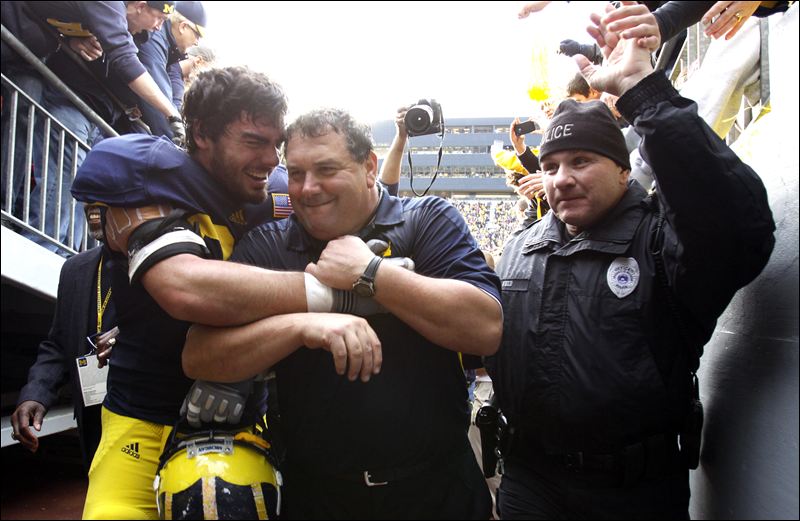
Showing posts with label Brady Hoke. Show all posts
Saturday, August 4, 2012
Expectations for Brady Hoke's Second Year
Last year, around this time, there was a lot to talk about in terms of news because Michigan had just hired new coach Brady Hoke and a lot of people were not entirely sure how his first year was going to go. We at the Michigan Fanatic wondered this as well, starting with the expectations for Hoke's first year.
As you can see, there were several priorities which hit the "High" mark in terms of our expectation: Most important was snapping the losing streak to Ohio State, and the second was showing remarkable improvement on defense. Snapping the losing streak to Michigan State also ranked on the extremely high mark.
Hoke snapped the losing streak to Ohio State, made Michigan competitive on defense, utilized Denard Robinson effectively, and won a BCS bowl, all of which is noted in the 2011 season-in-review post. Now Hoke enters his second year with arguably the most experienced offense in the conference, a potential Heisman candidate at quarterback, and great players at wide receiver, line backer, cornerback/safety, running back, and kicker, all of which are field tested and battle hardened.
So the expectations for Year Two are slightly different. Some are slightly higher, while others are slightly lower. You'll notice that there are less priorities in this go-around than last year's. That's largely because most of the priorities of 2011 were of a first-year coach, and Hoke has already achieved some of those.
1. Win the Big Ten Championship
Priority Level: High
Chalk this one up as Brady Hoke's No. 1 priority for 2012. He may have beaten Ohio State, he may have beaten Notre Dame, he may have beaten Nebraska, he may have won a BCS bowl, but as far as Brady Hoke is concerned, 2011 was a failure. Not a monumental failure, mind you, but he cannot reiterate enough how they failed to meet their goal, and their goal is to win the Big Ten championship.
The Wolverines have all the tools this year to signal that achieving this is not only possible, it is doable. Denard Robinson is a senior at quarterback. Michigan has depth behind him in Devin Gardner (who may be doubling as a wide receiver) and Russell Bellomy. Roy Roundtree is a senior. Jordan Kovacs is a senior. There is depth at running back with Fitzgerald Toussaint (whose current status is still undetermined) and Thomas Rawls. Vincent Smith is a playmaker. Even senior Will Campbell is looking to have a big year (the biggest of his career, actually) as the leader of the defensive line. All of the experience is there.
The only major concerns in Michigan's roster are on the offensive and defensive line. Team leaders such as David Molk at center, Ryan Van Bergen at defensive end, Mike Martin at defensive tackle, and Kevin Koger at tight end have all graduated. This leads some to believe that Michigan will, if anything, take a step back in terms of wins and losses. However, let's not forget that Hoke and Greg Mattison, both defensive line coaches who both stress that the game is won and lost in the trenches, took a 110th-ranked defense and made them the 14th-ranked defense. If they can do that in one year, I'm confident they'll manage the offensive and defensive lines. If there was ever a time where Michigan is poised to make a run at the conference championship (something they haven't done successfully since 2004), it would be now.
Granted, Michigan doesn't have the benefit that, say, Wisconsin does. The Badgers have a cakewalk to the Big Ten championship, with two powerhouse teams in the Leaders Division ineligible to even compete in the postseason. In the Legends Division (Michigan's division), all of the teams are eligible, and all of them except maybe Minnesota are legitimate contenders for the spot. Iowa, Michigan State, Nebraska, and Northwestern have just a good a chance as Michigan does of going to Indianapolis.
Last year I placed this priority at the Medium level because I thought it was more important for Hoke to snap the losing streaks to rivals and establish some momentum. While even this year individual games such as Michigan State receive the Extremely High priority level, winning the Big Ten championship is a very big deal this year. There is no reason why Michigan shouldn't be able to do it. Let's hope they can.
2. Defeat Alabama in Season Opener
Priority Level: Medium
Is anyone really expecting this to happen? I would say that I'm hoping for it, but not expecting it. Obviously the implications if Michigan is able to defeat the reigning national champions are enough to make any skeptical or cynical Michigan fan giddy with excitement over the possibilities. Michigan is currently ranked at No. 8 in the coaches' poll, which may seem a bit high. I had expected Michigan to be somewhere around the 20-22 ranking, much like Penn State was when they faced Alabama in 2011. But I suppose it kind of makes sense: if Michigan loses, they drop to anywhere from No. 20 to No. 25. If they win, people are talking national championship and Michigan is in the Top 5, maybe even No. 1.
Brady Hoke's first game of 2012 is no where near as important as was his first game of 2011. I had listed that game as "High" on the priority scale because Hoke needed to establish some early momentum and take home the inaugural victory that eluded Rich Rodriguez when he coached his first Michigan game against Utah in 2008. That expectation was based largely on what it would mean for the results. For him to be universally seen as a better coach, Hoke needed to be better than Rodriguez. That meant he needed to win his first game.
When Michigan meets Alabama in Dallas, Texas, in the "Cowboys Classic" on September 1, it won't be Hoke's first game as Michigan's head coach. It won't have any bearing on whether or not he can lead Michigan to the Big Ten championship. Even if they lose to Alabama, the following game is against Air Force in the Big House--a game which many Michigan fans consider the true season opener. Hoke will be able to recover from a loss with a win over Air Force. A loss to the Crimson Tide won't affect Michigan insofar as it will be probably the toughest game they play until Ohio State. It is possible for Michigan to lose to Alabama and still go 10-2.
3. Defeat Notre Dame to create a Four(!) year winning streak
Priority Level: Medium
I still cannot believe we won the night game last year. I still watch the last 1:41 on Youtube and cheer when Roy Roundtree caught that touchdown pass with only two seconds left in the game. I still go read Notre Dame liveblogs and open threads and see the panicking comments of Irish fans: how they freak out that Michigan has beaten them yet again, how they realize that they are now 0-2 when they were supposed to go undefeated, how they waive goodbye to a BCS bowl. It is glorious schadenfreude.
I didn't expect us to win that game last year. Michigan's priorities seemed more focused on getting the defense together and focusing on rivalry games like Michigan State and Ohio State, both losing streaks that needed to be snapped. Michigan already had a winning streak going against Notre Dame. I was also trying to get people to focus more on the MSU and OSU games because Notre Dame seemed like one we could very well lose, and I didn't want people unnecessarily getting all upset with Hoke when it was just his second game. But no, he won anyway, and that propelled Michigan to a 6-0 start. Thanks, Brady. Thanks for making me feel like an idiot for predicting a loss. (He did the same thing with the Nebraska game.)
To say that Notre Dame and Brian Kelly are feeling pressure to win this game is probably the biggest understatement of the year. Things are heating up for the coach in South Bend, and Brady Hoke did Brian Kelly no favors by exasperating the 0-1 start to 0-2--and in a last-second thriller no less. If Brian Kelly fails to beat Michigan for the third time in a row (which will make Michigan's winning streak over the Irish top out at four, which started with Charlie Weis's final loss in 2009), it will signal the beginning of the end for the Kelly regime and there will be people within the Irish fanbase saying he has to go.
Having played Alabama, Michigan will already be battle tested by the time they face the Irish in South Bend. Yet like the game against the Crimson Tide, this one has no bearing on Michigan's standing in the Big Ten. Michigan can lose to both Alabama and Notre Dame and still play in the Rose Bowl. The Wolverines have had the edge in the Michigan-Notre Dame rivalry as of late, and no one seems to know what that edge is. Maybe Notre Dame is experiencing the good old-fashioned irony of some perpetual bad luck. A win against them would be great, and it would further the notion of the Irish's woes. If nothing else, this game will be a good indicator of how Michigan performs against other teams outside the Big Ten.
4. Snap the Losing Streak to Michigan State
Priority Level: Extremely High
This isn't just a pride thing anymore. The Spartans are legitimate contenders for the Big Ten title for the third consecutive year, and they are Michigan's most palpable obstacle to the championship. It used to be that Michigan State was the little brother who couldn't keep up with Michigan, no matter how hard they tried. It's not that way anymore. No one is making fun of Michigan State these days. The era of incompetence under John L. Smith (colloquially called "Sparty No!" by Michigan fans) is over. Mark Dantonio has shown that he can coach. As one Michigan blog points out, the Spartans have transformed into a legitimate football team.
So this isn't just some pithy rivalry over who has bragging rights for another year, where Michigan fans have to sit back and take verbal abuse from Spartans and reassure themselves that things will be restored to the natural order next season, or where Michigan State fans have to grumble and grudgingly accept another loss to Michigan while dealing with their annual inferiority complex. This has become a true rivalry where Michigan State has just as much of a conceivable chance to get to the Big Ten championship as Michigan does. That means that winning this game is more important than ever.
The Spartans have their weaknesses, however. They'll be breaking in a new quarterback in Andrew Maxwell, who served as the backup to Kirk Cousins for two years. Even Dantonio has admitted that replacing Cousins--statistically Michigan State's best quarterback of all time--is a massive challenge. Naturally, MSU fans are confident Maxwell is up to the task, but the biggest question going into 2012 will be if he can replicate Cousins' abilities as a leader. They also lose key playmakers at wide receiver and running back. B.J. Cunningham, Keith Nichol, Keshawn Martin, and Edwin Baker are all gone.
Where the Spartans really shine is in their defense, which looks to be just as foreboding as it was last year. The priority for Michigan to put something together when they were unable to do in 2011 cannot be anything other than astronomical. The Wolverines are also playing them at home. In 2010, everyone hoped that a defeat of the Spartans would mark a turning point for Rich Rodriguez, but it didn't happen--Michigan was humiliated. When Hoke came in, everyone thought the change at the helm would mean a change in the in-state rivalry when he traveled to Spartan Stadium. It happened on the recruiting trail, but not on the field. If Hoke has any hopes of getting to the Big Ten Championship this year, this is a game he absolutely has to win.
5. Beat Ohio State
Priority Level: High
I know what you're thinking: how could this be anything other than Extremely High? Well, when it comes to Michigan and Ohio State this year, there isn't quite as much riding on the table. Hoke has already beaten them as a first-year Michigan coach, entering the pantheon of other recent coaches to do the same in their first years (Schembechler, Moeller, and Carr). The victory snapped the losing streak, so a lot of the pressure is off to do so, and a lot of the scrutiny of whether or not Brady Hoke is the "Right Guy" has dissipated for the same reason.
Ohio State is ineligible to compete for the Big Ten championship this year. That statement, in and of itself, has several connotations for The Game that will be played on November 24 in Columbus. It will effectively be Ohio State's last game of the season. It will also be the only opportunity Michigan has to play Ohio State in the season. (In some circumstances, Michigan and Ohio State could theoretically meet for a rematch in the Big Ten championship game. That is definitely off the table this year, ramping up The Game's importance to both sides.)
Brady Hoke might consider this priority Extremely High. In fact, he probably does. Nothing would be better than for Michigan to spoil Urban Meyer's first year as the Buckeyes' head coach by coming into their house in their last game of the season and coming home with a victory. It would be adequate payback for all those years where Ohio State left Michigan heartbroken in defeat. Make no mistake: regardless of the circumstances, The Game is just as important as it always has been. Some will say that is more important to Ohio State than it is to Michigan. That just means, for Michigan, it's all the more important to beat them.
Labels:
Brady Hoke,
Brian Kelly,
Mark Dantonio,
Urban Meyer
Thursday, June 7, 2012
Michigan’s 2013 Recruiting Class is Filling Up Quickly
There’s not a whole lot going on in the world of Michigan football these days. All’s generally quiet in Ann Arbor with the exception of the looming season opener with Alabama only three months away, and of course the stellar effort Brady Hoke and his staff have put together on the recruiting trail.
Probably the biggest reason why I don’t post about recruiting is very simply because I don’t want to get my hopes up until these players put pen to paper. A million things could happen before or even after signing day.
They could switch commitments, they could get in trouble with the law and lose their scholarship offer, they could not qualify academically, or even if they do commit and show up on campus, they decide for whatever reason to leave the team. Every team in college football faces this, and frankly it’s not worth devoting all kinds of energy to recruits who might not even pan out. People mainly talk about recruiting during the off-season because there’s nothing else to talk about.
I especially hate the notion that “you’re always going to have some attrition.” Brady Hoke is not the first coach to say this, but that doesn’t make it any better. Yes, I’m well aware that in an ideal world every recruit who commits stays in the program until he graduates, and in the real world this simply doesn’t always happen. I guess it’s because it happened more often than usual during the Rodriguez years that puts me a little on edge. You know the old saying about “once burned” and all that.
However, as should be obvious by now, there are a certain number of stories in Michigan’s recruiting world that have piqued my interest and have forced my hand. By “forced my hand,” I mean that I feel somewhat compelled to weigh in. This isn’t something that I’ll do frequently. I’m better off saying that I may do it once in a while than never at all. The point is you shouldn’t expect it.
For anyone who thought that Michigan’s amazing 2012 recruiting class was just a flash in the pan and that Brady Hoke was simply benefitting from the honeymoon period of a first-year head coach, you might be surprised to learn that Michigan’s 2013 class is shaping up to be just as impressive, if not more so.
After the initial commitment from Shane Morris (pictured above), Michigan landed nine commitments from February 18 to February 22, all of whom were four-stars. This clearly took the Michigan recruitniks by surprise and became one of the most intense recruiting weekends in recent memory. What now appears to be happening in recruiting circles is the debate about to whom the remaining offers should go to and from whom the remaining commits will come. In other words, “Who’s left?”
Michigan is currently up to 21 commitments (colloquially called “commits”) and has filled all of their positions of need: Shane Morris (Warren, MI) at quarterback, Jaron Dukes (Columbus, OH) and C’sonte York (Harper Woods, MI) at wide receiver, Deveon Smith (Warren, OH) at running back, Patrick Kugler (Wexford, PA) and Logan Tulley-Tillman (Peoria, IL) on offensive line, and defensive tackles Maurice Hurst Jr. (Westwood, MA) and Henry Poggi (Baltimore, MD). The assumption going forward was that Michigan was going to potentially use their remaining time (the rest of the year) and offers to pursue elite athletes.
This is called “star chasing.” The term emerged as a concern of USC coach Lane Kiffin’s recruiting tactics of pursuing the highest-rated skill players in the country instead of filling position needs, and especially in the wake of scholarship reductions. While most schools go “star chasing” when their needs are already met, Kiffin goes “star chasing” from day one. The results speak for themselves: Kiffin and USC have landed the No. 1 players at quarterback (Max Browne), running back (Ty Isaac), and most recently safety (Su’a Cravens), but virtually no guards or offensive tackles.
Ironically, Brady Hoke’s staff filled their needs with highly rated players in a recruiting effort that some believe is on par with Alabama. Patrick Kugler, the Michigan commitment to offensive guard, is the No. 1 rated offensive guard in the country. Recruit Wyatt Shallman is the No. 2 fullback. Kyle Bosch, Chris Fox, and David Dawson are the No. 4, No. 5, and No. 7 offensive linesmen in the country, respectively. Shane Morris is the No. 3 quarterback. Dymonte Thomas (Alliance, OH) is the No. 4 safety. Some might say this is ironic, but others would say it is to be expected.
It’s almost amusing to see how far Michigan has come from the days of constant attrition, lack of qualifying academically, and surprise injuries under Rich Rodriguez. The concern is now what Michigan will do now that all of its needs are met. Who will be the last remaining commitments? Michigan is reportedly holding a spot for Laquon Treadwell, a four-star wide receiver from Crete, Illinois. Treadwell has said that he doesn’t plan to choose a school until signing day (nearly eight months from now), but by that time it may be too late. Personally, I’m not going to hold my breath on Treadwell. The fact that he hasn’t committed yet only means that he isn’t as interested in Michigan as everyone thinks. If he was, there’s nothing to stop him from committing.
Michigan’s most recent commitment from a long-snapper Scott Synpiewski (Ottawa, IL) is an interesting story in and of itself. Synpiewski is not rated and not ranked. This is not because he isn’t good; it’s probably because he’s a long snapper. That position is typically filled by a walk-on rather than a scholarship player, not just at Michigan, but practically everywhere. Most long-snappers are the anonymous, unsung heroes of field goal teams. Even place kickers get more recognition. So why did Michigan offer him a scholarship at all? Well, the purveying rumor is that Hoke’s staff wanted to lock down someone after Michigan State poached their last walk-on long snapper.
The greater concern is that this significantly limits the remaining spots available, assuming one is still open for Laquon Treadwell. In a class that is supposed to finish at 22 to 23 signees, Michigan currently has 21 commitments. That means that there are only one or two spots left.
This all must be frustrating news for Berkley Edwards, who has been hoping for an offer from the Wolverines but has yet to receive one. Berkley is the younger brother of Braylon Edwards, who wore #1 at Michigan as a wide receiver and famously caught the touchdown that won an overtime thriller against Michigan State. Braylon took to Twitter a while ago and publicly complained that his brother was getting overlooked and that Michigan should offer Berkley a scholarship. Berkley plays running back at Chelsea High School in Chelsea, MI. He supposedly can also play wide receiver, but running back is reportedly where his heart is. This is a problem because most of the Big Ten powers (Michigan, Michigan State, Ohio State, Nebraska, etc.) are all set at running back, and while he may be underrated, it’s just as possible that he’s suffering a case of bad timing.
Braylon Edwards claims that his brother has elite speed, and indeed he does (4.4 is nothing to sneeze at), but Michigan already got a running back with Berkley Edwards’ size and speed when Dennis Norfleet of Martin Luther King High School in Detroit signed with the class of 2012. Berkley Edwards’ two best offers are currently from Cal and Minnesota. More offers could be on the way, and it will be interesting to see where he ends up. If Michigan does offer him it will be as a wide receiver, not as a running back. Berkley would then have to decide which is more important to him: the position, or the school.
Michigan has largely taken the recruiting world by storm by landing so many commitments in such a short amount of time. Their class is practically full, and it’s only June. This has intimidated some of the fans of Michigan’s rivals, while both placating and worrying Michigan’s fans. Even Hoke’s staunchest supporters don’t entirely know what to make of this. Before he arrived at Michigan, the general truism with regards to recruiting was “It’s a marathon, not a sprint.” Hoke has apparently changed the game on that.
He’s also looking more and more like the real deal.
Labels:
Berkley Edwards,
Brady Hoke,
Braylon Edwards,
Lane Kiffin,
Shane Morris
Thursday, May 24, 2012
The Year of the Hoke: Reviewing the 2011 Season
As we approach the 2012 season, it’s important (or, at least, it should be) to glance over what went down last year, and where the program is going forward.
Of course, there’s more to 2011 than simply Michigan getting to 11 wins that included a BCS bowl victory. There was substantial improvement on defense, defeating an old rival, meeting expectations, and even exceeding them. But was Michigan’s 2011 season an unmitigated success? Let’s take a look.
Biggest Hits
Beating Ohio State
If there was one accomplishment, one development, that absolutely cannot be overlooked, it is Brady Hoke’s first win over Ohio State as Michigan’s head coach. He had seen victories over the Buckeyes during his tenure as a Michigan assistant under Lloyd Carr—as the defensive line coach from 1995-2002, until he was offered a head coaching gig at his alma mater, Ball State—but a win as the head coach of the Wolverines in his inaugural season must have been infinitely more satisfying.
“It would be the ultimate validation of his stewardship and confirmation of his methods,” wrote Ohio State blogger Ramzy Nasrallah the week before the Michigan-Ohio State game. Michigan would enter the contest with the reminder that they had not beaten the Buckeyes in nearly 3,000 days. Through the efforts of Brady Hoke, his staff, the team captains, and all the players who pulled together, the losing streak was snapped. For once, the Michigan faithful could finally breathe easy as they neared the end of the year.
Beginning with the fateful victory over Ohio State in 1969, when the new era of Michigan football was ushered in under Bo Schembechler, every Michigan coach since then (Schembechler, Gary Moeller, Lloyd Carr) had won their initial game against Ohio State—save one: Rich Rodriguez. Ever the “Michigan Man,” Brady Hoke restored that tradition to its rightful place.
Starting Strong
On September 1, 2008, Rich Rodriguez received the first piece of evidence that his spread offense probably wasn’t the best fit for Michigan when the Utah Utes stuffed any attempt the Wolverines made to get yards. The once-proud Wolverines lost the game 25-23, ensuring that the first game of the Rich Rodriguez Era was a disappointment—the first of many to come. “Don’t leave the Rodriguez bandwagon early,” wrote Dan Feldman of the Michigan Daily after the game. Rodriguez’s Wolverines would go on to win only three games in what became the absolute worst season in Michigan football history.
Brady Hoke’s first game against Western Michigan on September 3, 2011 was the first, necessary step into restoring Michigan’s reputation. The Wolverines defeated the Broncos 34-10, although the game was cut short in the third quarter because of thunderstorms. Nevertheless, Michigan’s ability to take control of a game they had every right to win proved that Hoke and his staff knew their stuff and knew how to coach it. For the first time since Lloyd Carr, it finally seemed like Michigan was going to meet some expectations.
The next game against Notre Dame was another huge test, and the Wolverines pulled out that one in a last-second thriller, forcing the Irish to start their season at 0-2. Though I personally didn’t expect Hoke to walk away from that contest victorious, it was definitely a pleasant surprise and another reminder that Hoke was serious about big, important games.
With the Wolverines coached competently on defense (finally!), Michigan was able to start 6-0 against several opponents that, with less competent teaching, they may have easily lost to, such as Hoke’s old team in San Diego State or Pat Fitzgerald’s ever-unpredictable Wildcats of Northwestern. Michigan also made a statement in the Big Ten by winning its conference opener against Minnesota 58-0. Rather than having to escape every game—which was how Rodriguez’s teams were able to start undefeated in 2009 and 2010, only to be crushed and humiliated by legitimate teams in the later part of the schedule—the Wolverines under Hoke were actually able to force some three and outs, resulting in decisive wins.
Finishing Strong
One of the biggest reasons why Rich Rodriguez’s seasons became “disappointments” was because the way they ended. In 2009 and 2010, the Wolverines won a combined four games in October and November for both years. This put added pressure on the players (and the seniors) to beat Ohio State, and they were never able to do it. When January came around, the winters were a lot colder, and Rodriguez’s seat was a lot hotter.
While in 2011 Michigan put up three signature victories in October (dropping only Michigan State), it was their run in November that truly allowed the Wolverines to make a visible difference. A strong defensive stand against Illinois, a 45-17 beatdown of a favored Nebraska, and finally snapping the losing skid against Ohio State was a November Rodriguez’s players never saw.
It quickly became clear that Hoke and Mattison got fundamental on defense, while Al Borges focused more and more on how to make a spread/pro-style hybrid offense. The competency of the coaches carried over to the players and showed a clear distinction against Rodriguez’s staff, where losing in November was not only dreaded, it eventually became expected. Hoke’s ability to break the tradition of losing during November stretches that had gripped Michigan’s football program for the past three years helped solidify him as Michigan’s man.
Vast Improvement on Defense
There was perhaps no question more asked of the Michigan football program going into the 2011 season than “What about that defense?”
Throughout all of 2009 and 2010, in the waning months as the Rodriguez era slowly and steadily reached its end, there seemed to rage an eternal debate about the nature of Michigan’s increasingly porous defense and what could be done to fix it.
The initial reaction was that it was the players: lack of talent because of heavy attrition, injuries, and the inability of a few recruits to gain admission to the university. (The best example of the third is Demar Dorsey, a highly-rated cornerback whom Rodriguez and company banked a great deal of their hope on, only to discover that his poor grades made the admission department deny him admission. Yet another reason why Rodriguez’s philosophy clashed with Michigan’s standards.)
When season after season passed, the debate eventually shifted to the coaches, although some still held firm to the notion that Rodriguez was doing everything he could. The defense was so bad in 2010 that, finally, fans started to question the direction Rodriguez was taking the program, after the questionable hire of Greg Robinson. (Most of Rodriguez’s most ardent supporters, to this day, believe that Greg Robinson is chiefly, if not solely, to blame for the defensive struggles.)
The hiring of Brady Hoke not only brought a defensive-minded head coach, but also a surprisingly elite hire in Greg Mattison, former defensive coordinator of the Baltimore Ravens. Together they taught and re-taught the same Michigan players fundamentals, technique, and preached toughness, and the defense went from being 110th in the country to 14th. That ended the debate. It was always coaching.
Going to the Sugar Bowl
This one was really unexpected. It was a fitting end to a great regular season. I don’t think there was a single Michigan fan out there who anticipated that the Wolverines would get to 10 wins and a BCS bowl. Maybe eventually, but in year one?
Mike Martin said in a video that one of the reasons why he committed to Michigan was because he expected to go to BCS bowls every year. Obviously, the last time Michigan played in a BCS bowl was against USC in the Rose Bowl in January 2007. After Lloyd Carr retired, Michigan endured something of a bowl drought for two years under Rich Rodriguez. In 2010 they were finally bowl eligible but got humiliated 52-14 by Mississippi State in the Gator Bowl.
Coming from that drought makes the BCS bowl berth after the 2011 season all the more surprising and all the more impressive. For seniors like Mike Martin, who when they committed to Michigan had hoped to be there every year, it was good of them to finally get there. Their effort brought Michigan back to national relevance.
Biggest Misses
Losing to Michigan State
The most notable and palpable blemish on Hoke’s record so far has been the loss to in-state rival, Michigan State. Michigan—which previously dominated the rivalry for six straight years, winning every contest from 2002 to 2007, and before that was victorious for 14 games over 20 years—has now been on the losing side of the rivalry, falling to the Spartans four straight years in a row.
Granted, it’s nowhere nears as bad as the Spartans’ record in the rivalry, but this is something that Michigan is not used to. Lloyd Carr was known for almost never losing a game to the Spartans, even when he was at his most complacent. It wasn’t until Rodriguez arrived that the rivalry quickly turned and got worse every year. When Brady Hoke arrived, that was supposed to change. It didn’t.
This isn’t to say that Hoke hasn’t made necessary steps in the rivalry. Locking down nine of the top ten players in the state of Michigan for 2012 certainly helped, as well as landing five-star quarterback Shane Morris for the class of 2013, a development which sent Spartan fans into a harried frenzy.
But domination needed to happen on the field.
Michigan’s game against Michigan State in Spartan was an embarrassment on all levels. Not only did both teams look ridiculous with hideous uniforms, but Michigan State somehow won despite giving up over 100 yards in penalties. It was surprising to see Michigan lose after all the strides they’d made in discipline, and they were clearly more disciplined than the Spartans, but they just couldn’t produce.
Performance in the Sugar Bowl
Though some of this can be chalked up to pre-game injuries, Michigan’s offense in the Sugar Bowl didn’t exactly play their best game. It’s hard to say anything bad or good about Michigan in the Sugar Bowl because, well, they won. They won ugly. So does how they won matter?
In terms of this review, yes. With the high of winning the Sugar Bowl now gone because enough time has passed, it’s fair to say that Michigan’s performance in the game was somewhat of an embarrassment. After all the talk that Michigan and Virginia Tech didn’t deserve to be in the game in the first place, for Michigan to come in and have such inept offensive performance (the defense, while keeping Michigan in the game, although simultaneously gave up huge yards on third down, keeping VT in the game) that eeked out a close win in overtime was more of a negative than a positive. While Michigan fans and players were happy that they had fought hard to get the win, it also gave Michigan’s detractors more fuel because, let’s face it, that game was not fun to watch.
You won’t find too many Michigan bloggers or fans saying anything about the Sugar Bowl other than “a win is a win,” but if Hoke’s Wolverines had a moment when things could have and should have gone better, this was arguably it.
The Way Forward in 2012
To cite any expectations for the coming season with the phrase “Obviously this needs to happen” would be both pedantic and premature. There are numerous reasons why the Wolverines will be able to replicate a lot of their success from 2011 into 2012: the fact that they return playmakers like Denard Robinson, Fitzgerald Toussaint, Roy Roundtree, Jeremy Gallon, behind a stout offensive line that features seasoned veterans like Taylor Lewan and Patrick Omameh, as well as defensive standouts like Jordan Kovacs, Kenny Demens, Craig Roh, Jake Ryan, and Blake Countess is all very encouraging.
The primary concerns are on the lines themselves. This is understandable, since huge question marks were left when David Molk, Mike Martin, Ryan Van Bergen, and Kevin Koger (a tight end) all graduated. The question apparently is if the 2012 seniors can fill those shoes. (I’d personally be more worried about the lines if Hoke himself wasn’t a defensive-line coach at heart.)
The schedule is considerably less forgiving. Still, Brady Hoke must have the game against Michigan State circled in red. It is played at home, and with the Spartans losing almost all of their offensive weapons (quarterback Kirk Cousins, receiver B.J. Cunningham, running back Edwin Baker, receiver Keshawn Martin, and receiver/tight end Keith Nichol are all gone), the Wolverines should have a distinct advantage. (I should note that Michigan State’s defense returns almost all of its starters and will arguably be the best in the Big Ten.)
I won’t get too much into previewing the 2012 season just yet, but suffice it to say that several teams will be gunning for Michigan (Alabama, Notre Dame, Nebraska, and Urban Meyer-led Ohio State). The Wolverines will certainly have their hands full.
You’d think that with such daunting expectations Brady Hoke would be worried, but he isn’t. If anything, he feels the 2011 was a failure because they didn’t win the Big Ten championship.
Imagine that, all the success Michigan had, and somehow they still failed. That driving hunger, that eternal desire of always wanting more is something Michigan has lacked for a long time, and it shows that Hoke is the perfect guy for the job. He can handle it. Michigan will be just fine.
Labels:
Brady Hoke,
Greg Mattison,
Mike Martin,
Rich Rodriguez
Tuesday, April 24, 2012
Russell Bellomy Brings Solid Depth to Quarterback Position
At Michigan’s 2012 spring game, the play on the field was largely vanilla—no deep passes were thrown—but it did provide the coaches with an opportunity to get their backup players some reps. If you missed the spring game, you can see it in its entirety here.
Most notably in the scrimmage came the play of quarterback Russell Bellomy, the 6’3” 185-pound redshirt freshman from Arlington, Texas. According to Michigan’s coaches, he is third behind Denard Robinson and Devin Gardner. However, based on Bellomy’s performance in the spring game, he could be a lot closer to the getting the backup job than Gardner is to keeping it. You can see all of Bellomy’s offensive snaps in the game here.
Bellomy was one of the late recruits to Michigan’s 2011 class, committing in the first weeks of Brady Hoke’s hiring. Offensive coordinator Al Borges said that Bellomy “was recruited by some teams that I have a lot of respect for recruiting quarterbacks.” (Borges is likely referring to Purdue, Boise State, and Michigan State, all of whom offered Bellomy scholarships and all of whom have developed outstanding quarterbacks. Bellomy was previously committed to Purdue before his Michigan offer.)
“When I first got here,” Borges told reporters back in February 2011, “there was no recruited quarterback, so we were trying to find a quarterback. After looking at [Bellomy], doing some quick research, a quick cram course on all the kids that were candidates for the scholarship, he checked out at every turn. I talked to several coaches who were recruiting him—maybe they had already signed a quarterback, but [they] were really, really high on him. I got great reports. That, but even more so, the research I did on my own—having a chance to watch tape and talk to his coach—I was sold on the kid.”
It’s amazing how Bellomy was only rated as a three-star quarterback coming out of high school when his highlight tape looks more like that of a five-star quarterback. (Seriously, it is more impressive than No. 1 2012 quarterback Gunner Kiel’s.) Bellomy has really good accuracy (then for a high school senior) and a really strong arm, and he’s not limited to the pocket. If you watch his tape, he has some decent wheels and can definitely be considered a dual-threat.
So, why the low rating? MGoBlog's Tim (the site's recruiting blogger at the time) seemed to think it was because of Bellomy’s long-standing commitment to Purdue before he switched to Michigan. Recruiting websites have little regard for the Boilermakers, whom they consider to be a mid-level Big Ten team, and they sometimes grade their recruits unfairly. Also, consider this: skilled quarterbacks in the state of Texas are a dime a dozen, and it’s possible Bellomy was overlooked because of the sheer quantity of quality Texas recruits. (This would also explain why for the past few years the No.1-rated quarterbacks have come from states that have significantly fewer blue-chips: Gunner Kiel from Indiana, and Max Browne from Washington. Talent tends to stick out in an area where it is uncommon.)
Nevertheless, I cannot say enough how much I like this guy. Bellomy’s phenomenal high school highlight reel aside, he was good enough to be the main quarterback on the scout team and kept the defense on their toes enough to prepare them for 2011’s toughest challenges.
Before Bellomy even had an offer from the Wolverines, he came off as a humble yet determined, team-oriented Michigan Man in the making. Bob Wager, Bellomy's high school football coach, described him as "an outstanding student," having "a 4.0 GPA academically and a 1100 plus on his SAT."
"He’s done a masterful job of maintaining the balance of being a student-athlete," Wager told Go Blue Wolverine, Michigan football's premier (but unofficial) recruiting site. "He’s a team captain, as voted by his teammates, which I think is one of the great honors you can have. I think he’s going to make the team better and the campus better the moment he steps on because of the type of person he is . . . In Russell’s words, Michigan was one of his absolute dream schools. I think certainly anytime you go up to that environment, even here in the great state of Texas, we recognize the fact that Michigan is one of the premier football traditions in all of college football and I’m sure that had a profound impact to have an opportunity to go up and visit Ann Arbor."
Brady Hoke and Al Borges got themselves a major steal with this one.
The 2012 spring game was a bit of a validation for anyone who saw Bellomy’s highlight reel and concluded he was the Real McCoy, a solid, competent game manager—which is always satisfying to throw back in the faces of the doubters. Of course, what naturally emerged from Bellomy’s performance was a discussion of what this means for backup quarterback Devin Gardner, who has continued to struggle not only in spring games but also in actual games. Gardner’s first snap in his 2010 spring game debut was a fumble, but it was largely written off because he was then a freshman. He is now a junior.
“If Gardner's been really good and Bellomy uninspiring but solid and mistake-light throughout the spring, only one of these traits came through on Saturday,” wrote MGoBlog’s Brian after the 2012 spring game. “In three consecutive spring games [Devin Gardner has] looked bad.”
This also came after the recent speculation and rumors that Devin Gardner might be switching his position to wide receiver, and that he might actually be doing really well there—which shouldn’t come as a complete surprise. Gardner is a raw athlete who has always shown impressive speed as a scrambler and, at 6’4”, 205 lbs., he’d be the tallest wide receiver on Michigan’s roster.
In terms of Michigan’s coaches putting the best players on the field, and Gardner actually getting some more frequent playing time before he graduates, this is not a bad deal.
Last year I profiled Devin Gardner as a “Player to Watch in 2011” largely because I figured that his tall frame was better suited to a pro-style, pocket pass-focused offense than was Denard Robinson’s 6’0” frame. I also thought that, even with Gardner regulated to the backup position, he would still be eventually better suited to run the offense in the future. These thoughts are now shown to be somewhat shortsighted and were possibly obscured by the fact that Gardner was a five-star quarterback coming out of high school and the nation’s No. 1 dual-threat quarterback prospect of 2010.
Much like Fitzgerald Toussaint securing the feature running-back position, Denard Robinson has become the unanimously clear choice as Michigan's feature quarterback. I would be shocked if he lost the starting job to either Gardner or Bellomy. The battle between the two of them now seems to be for the backup job, and Bellomy has the advantage.
This isn’t a bad thing. For the first time since 2007, Michigan finally has depth at quarterback. With Warren De La Salle’s Shane Morris joining the roster in 2013 after Denard graduates, we can finally stop worrying about Michigan’s quarterback position. Even if Morris doesn’t nab the starting job as a true freshman and Gardner is moved to wide receiver for the remainder of his career, Bellomy will by then be capable enough to be the starter and manage the offense while Morris develops.
Brian Cook’s Hail to the Victors magazine wrote in 2011 that “a lack of recruiting stability was rare in Bo Schembechler’s era” at Michigan. The same was true of quarterback stability, even through the Lloyd Carr era.
For the first time in a long time, that stability has returned.
Labels:
Al Borges,
Brady Hoke,
Denard Robinson,
Devin Gardner,
Russell Bellomy
Thursday, February 2, 2012
2012 Signing Day Recap and Overview
Yesterday, February 1, 2012, twenty-five high school prospects signed their letters of intent to officially join the Michigan football program. The University of Michigan athletic department released a general run-down of all the committed players.
Here’s a quick list of all the players:
OL Blake Bars (6’5”, 270 lbs.)
LB Joe Bolden (6’3”, 230 lbs.)
OL Ben Braden (6’6”, 319 lbs.)
WR Jehu Chesson (6’3”, 175 lbs.)
DB Jeremy Clark (6’4”, 195 lbs.)
WR Amara Darboh (6’2”, 200 lbs.)
TE Devin Funchess (6’4”, 205 lbs.)
DB Allen Gant (6’2”, 205 lbs.)
DT Matt Godin (6’6”, 265 lbs.)
DT Willie Henry (6’3”, 273 lbs.)
FB Sione Houma (6’0”, 215 lbs.)
LB Royce Jenkins-Stone (6’2”, 215 lbs.)
RB Drake Johnson (6’1”, 205 lbs.)
OL Kyle Kalis (6’5”, 305 lbs.)
OL Eric Magnuson (6’6”, 275 lbs.)
RB Dennis Norfleet (5’6”, 165 lbs.)
DE Mario Ojemudia (6’2”, 220 lbs.)
DT Ondre Pipkins (6’3”, 320 lbs.)
DB Terry Richardson (5’9”, 165 lbs.)
LB Kaleb Ringer (6’1”, 225 lbs.)
LB James Ross (6’1”, 215 lbs.)
DE Tom Strobel (6’6”, 265 lbs.)
TE A.J. Williams (6’6”, 275 lbs.)
DB Jarrod Wilson (6’2”, 190 lbs.)
DE Chris Wormley (6’5”, 250 lbs.)
As I’ve said many times, I don’t normally follow recruiting or have time to post about on this blog when so many other outfits can do so. They dedicate a lot of time to it. I have made a few posts, however.
There’s also a big element of unpredictability about recruiting: you never know when a player is going to decommit, or if something equally bad is going to happen. This is also why I don’t like to make posts about recruits who haven’t signed. However, now that these guys have all signed their letters of intent (LOI), they’re officially part of the Michigan football family, and we can talk about them without worry. (Note: Even in the best programs, attrition is always existent. Just because a player commits and signs a LOI doesn’t mean they won’t transfer because they can’t cut it in practice.)
Anyway, let’s talk about this class. Generally, I think it’s pretty good. Brady Hoke’s staff addressed all of the major needs (offensive line, tight end, defense, etc.) while still pulling in some great skill players at running back and wide receiver.
So, how does this class rate? Scout.com ranks Michigan as No. 4 behind Alabama, Texas, and Ohio State. Across most sites, Michigan and Ohio State are tied for best class in the Big Ten.
Best Prospect on Offense: Kyle Kalis
Michigan really needed some depth at offensive line, and Kalis is an amazing get for a number of reasons. Probably the biggest one is that he decommitted from Ohio State to become a Wolverine. Kalis is big, tough, and strong and will likely play right away. He is arguably Michigan’s highest rated recruit on the board.
Runner-up: Amara Darboh
Darboh is a four-star wide receiver from Des Moines, Iowa that was very high on Notre Dame’s list of targeted recruits. It was pretty big news when he chose Michigan over Notre Dame, and some Irish fans are legitimately getting worried.
Best Prospect on Defense: Ondre Pipkins
Ironically nicknamed “Pee Wee,” Pipkins is huge and ready to go. Not only does he fit into a crucial defensive line need—with Michigan losing Mike Martin—but he was also desperately wanted by the Michigan State Spartans. Pipkins had offers from Alabama, Florida, Ohio State, Oklahoma, Oregon, and USC, among many others. He is considered one of the top ten best defensive tackles in the entire country, earning a four-star rating from Scout and a five-star rating from Rivals.com.
Runner-up: James Ross
Ross was an early commit to Michigan back in 2011 and that news became hugely disappointing to schools like USC, Ohio State, and Penn State, but Michigan State was particularly bitter about this one. Ross has an incredibly high football I.Q. to counteract his size, and he is probably the best tackler in the Midwest. If Ross lives up to his potential, he will likely become one of the best linebackers in Michigan football history.
But really, this whole class is rated incredibly high, which you would expect from the No. 4 class in the country. Chris Wormley, Mario Ojemudia, and Devin Funchess were all four-star recruits nabbed to the chagrin of Michigan’s rivals. Michigan only lost one commitment in the whole process—Caleb Stacey, who switched his commitment to the University of Cincinnati because he wanted to stay close to home. (Stacey is from Cincinnati.)
There’s plenty to like about each prospect, and it’s hard to have one favorite. Running back Dennis Norfleet was a surprise get for Michigan because he committed the day of Signing, changing his commitment from Cincinnati (which nabbed Caleb Stacey) to Michigan at the last second.
Norfleet is a four-star rated recruit on Scout and is considered the No. 19 best running back in the country. He also happens to be from Detroit, which may explain why he thought he was being overlooked. At mgoblog.com, Brian Cook was pretty excited that Michigan got Norfleet:
Yessssss. Schools should recruit guys like Norfleet like they do kickers: have at least one on the roster at all times and maybe stash a second away so you've always got a quality specialist. With Justice Hayes Michigan now has two bullets in the space-player chamber.
Norfleet will instantly be in the mix for both return jobs. While Jeremy Gallon is likely to hold on to punt return duties, kickoff returns could use a jolt of athleticism after Martavious Odoms and Vincent Smith split duties this year.
As far as a role on offense, he'll probably spend a year backing up Vincent Smith before fighting with Hayes for third down back. If Michigan really is moving to a "pro style" offense they'll have to define whether that means aimlessly running power over and over or pairing guys like Hayes and Norfleet with Shane Morris to create a Brees/Brady-style deadly passing spread. Survey says: some of both. Norfleet could have an impact in the former and will be a centerpiece in the latter.
Norfleet is pretty much a consensus four-star running back across the board, but if he wants to have early playing time, he’ll have to beat out Fitzgerald Toussiant in 2012, and probably Thomas Rawls down the road.
Signing Day always has its ups and downs, because nothing is official until the school gets that letter of intent in the fax. The athletic department followed the events on Signing Day, and you can view Part 1, Part 2, and Part 3 if you want to see the staff nervously await the faxes to come in. Brady Hoke also gave a press conference where he talked about each of the recruits. AnnArbor.com has a transcript of Hoke’s comments on each recruit, if you’d rather read than watch.
CBS coverage of Signing Day interviews Brady Hoke:
And of course, Michigan alumnus and Wolverine fan Bob Wojnowski took the opportunity to relate Michigan’s recruiting back to its rivalries:
To build in the trenches, you have to fight in the trenches. To gain ground, you have to stand your ground. College football teams don't win merely by collecting the biggest recruits, but it's not a bad way to try. And right now in the Big Ten, there's some old-fashioned, backyard, bare-knuckle brawling going on.
Michigan is a Midwest recruiting force again under Brady Hoke. Ohio State's scandal cost it, oh, about 15 minutes of recruiting time before Urban Meyer cranked it up. Mark Dantonio and Michigan State aren't shying away, but it's a scrap again, sooner than expected.
After a three-year respite, Michigan is back to encroaching on Michigan State's territory, and trying to reclaim its own. Ohio State is back to encroaching on Michigan's territory, and Michigan State's territory, and Penn State's territory. Ohio State and Michigan hauled in the Big Ten's top-rated classes Wednesday, both hovering in the top five nationally…the Wolverines did an excellent job loading up with the type of players they needed — offensive and defensive linemen, and guys who tackle. Of their 25 recruits, 18 are from Michigan and Ohio. Of the Buckeyes' 25 recruits, 15 are from Ohio. Of the Spartans' 18 recruits, 11 are from Michigan and Ohio. So you can understand if the Spartans are feeling a little territorial. They had their pick of the state while Rich Rodriguez was chasing fast guys all across the country, and they posted back-to-back 11-victory seasons and beat the Wolverines four straight times.
The battling is here to stay, on the field and off. Meyer brings an SEC raid-everyone's-commit-cupboards mentality. Hoke brings an old-school devotion to trench warfare…This is how great rivalries get stoked, when players stay close to home and understand what's at stake. There's no sense getting starry-eyed on the first day of February, because for every 5-star bust, there's a 3-star phenom. The recruiting experts can declare the winners. I'll simply declare the Big Ten got top-heavier, and the scrapping to hold ground and gain ground just got a lot more intense.
How did the rivals do?
Michigan State: their best recruit is indisputably wide receiver Aaron Burbridge, the best wide receiver in the state of Michigan, and the only player who chose to be a Spartan over being a Wolverine. (To be fair, though, Michigan’s staff was recruiting him less and less when it was discovered that he struggled in the classroom.)
The Spartans are miffed about losing Mario Ojemudia and Devin Funchess, two prospects who came from Farmington Hills Harrison, widely believed to be a Michigan State pipeline. They’re also upset about losing James Ross, who comes from Orchard Lake St. Mary’s, a high school that has been divided in its love for the Spartans and the Wolverines.
Ohio State: the Buckeyes’s best prospect is probably running back Brionte Dunn, who was heavily fought over between Hoke and Meyer, and who was heavily considering coming to Michigan. Meyer won the battle, though.
Either in spite of the sanctions or because the sanctions aren’t tough enough, Ohio State has tons of elite prospects. Michigan was able to nab Kyle Kalis away from Columbus, but the Buckeyes landed the commitment of cornerback Armani Reeves, another hotly contested prospect by both schools. It seems that the Michigan-Ohio State rivalry is going to heat up even more—if that’s possible.
Notre Dame: their best prospect is clearly Gunner Kiel, the No. 1 best quarterback in the country. Kiel had originally committed to play for Indiana under Kevin Wilson, and then he switched to LSU. A few weeks before Signing Day, Kiel switched again to Notre Dame, this time for good. He doesn’t exactly fit Brian Kelly’s offense (Kiel is a Grade A pocket passer), but he has a powerful arm and lethal accuracy. Kiel’s commitment upped Notre Dame’s ranking to have the No. 18 best class in the nation.
With Michigan filling all of its needs and securing some of the best talent away from their rivals, it’s hard not to get excited about this class. Brady Hoke clearly established a very impressive foothold in the Midwest and brought the primary efforts of recruiting back to the states of Michigan and Ohio.
It’s an exciting time to be a Michigan fan. But then again, it should be.
Wednesday, January 4, 2012
Michigan Kicks Off 2012 with Sugar Bowl Win
After watching Michigan's 23-20 overtime victory over Virginia Tech, if you thought that Michigan had a lot of the same luck as they did against Notre Dame—well, you'd probably be right.
Pretty much everything about this game that needed to be said has been said. Maize n' Brew (after a long hiatus) returns with an extensive recap of the game, in case you missed it. ESPN also posted highlights. The play that literally won the game was a field-goal kick by Brendon Gibbons in overtime.
When asked what was going through his mind when Virginia Tech coach Frank Beamer called a timeout to ice him, Gibbons said, "Brunette girls. Every time we were struggling with the kicking, Coach tells me to think about girls on the beach or brunette girls. So that's what we did. Made the kick." This quote is sure to find its way into both Michigan football lore and infamy.
And, of course, Brady Hoke delivers some great words on the win.
Here are a few thoughts:
- There were two or three moments that decided the game. All of them came in overtime, in the last minute of play. The first was the call that overturned Danny Coale's would-be catch in the endzone. The second was VT kicker Justin Myer's missed field goal. And needless to say the third was Brendon Gibbons' field goal kick. Each of these moments has equal value. If the call had not been overturned, Michigan would have had to go for a touchdown. If Myer had not missed the field goal, Michigan would have either had to go for a touchdown to win or make a field goal to send it into another overtime. And, obviously, if Gibbons hadn't made the field goal, Michigan and Virginia Tech would have played another round. This is exactly why college football overtime is so "sudden death." Those who say that Coale's overturned catch decided the game would be wrong. Michigan didn't win by default. They had to make a field goal. Because they did that, they won.
- Seth at MGoBlog takes an objective look at whether or not Coale in fact made a catch. My opinion is that it was not a catch because Coale, despite great effort, did not have possession of the football. This Virginia Tech fan obviously disagrees. (Although, to be fair, there were plenty of VT fans who saw the play and weren't sure if it was a catch.)
- Not having Rimington Award (Best Center) winner David Molk in the opening drive was huge. Molk apparently sustained a foot injury in pre-game warm-ups, and Rocko Khoury (Molk's backup center) went in and struggled to click with Denard Robinson. Khoury is slated to be Molk's replacement for next year, but he doesn't yet have any chemistry established with Denard that Molk took years to build. Khoury will be a senior and will undoubtedly be the starter—Michigan has no one else—and will have to master the role quickly over the offseason.
- The general consensus even among Michigan fans is that Michigan did not deserve to win this game, and they got both outplayed and outcoached by Virginia Tech. I generally disagree with this. While the numbers are clearly not in Michigan's favor—on offense, especially, as Michigan only gained 184 yards to VT's 377—Michigan absolutely played their hearts out to eek out a win. Both David Molk and Ryan Van Bergen were playing with injuries. They would not be denied.
- As for the "outcoached" thing, Frank Beamer's known forte of special teams was clearly not up to par. First, there is the instance where Beamer opted for a "punt option" in which wide receiver/punter Danny Coale faked the punt, ran, then tried to punt, and got tackled—resulting in a turnover on downs. Beamer admits this was a coaching decision. In the first half, after Michigan scored a touchdown to go up 7-6, Virginia Tech fumbled the kickoff return to give the Wolverines a chance to get more points within the VT forty yard line. That play wasn't ineptitude on Virginia Tech's part. Like they have done so many times this year, Michigan forced the fumble and swarmed to the ball. If there is a tangible difference to the coaching between 2010 and 2011, it is that.
- I have nothing but respect for Coach Beamer. Virginia Tech fans should not be upset that he hasn't won a BCS bowl since 2008. For the past seven years, Beamer's Hokies have consistently had seasons of ten wins or more. Virginia Tech has gone to a bowl game every year for the last eighteen years. Beamer is a guy who runs a program the right way. He should never be in the hot seat.
- This probably goes without saying, but it's kind of ironic that the two worst aspects of Michigan's gameplay (defense and special teams, kicking game) in 2010 would be the stopping power of 2011, and nowhere was that more apparent than the Sugar Bowl. We've said many times that Michigan's improvement has been exceptional. More importantly, Michigan showed that when the offense was stagnant, the defense could hold firm long enough for someone to make a play.
- If there was one word that sums up Michigan football in 2011, it is "improbable." From the thrilling last-second victory over Notre Dame to the throttling of Nebraska to the clutch interception that sealed the deal against Ohio State, Michigan has taken a team that probably should have never been in the Big Ten and has become competitive despite obstacles and probabilities of defeat. The carry-over from Rodriguez's era is still apparent, but the coaches and the seniors and everyone involved in the Michigan football program won a lot of their games through sheer determination alone. The prospect of defeating Alabama come this fall is dubious at best, but at least the Wolverines have a lot more going in than they've had over the last three years—and that's a fighting chance.
Saturday, December 31, 2011
Brady Who?
There is a story in Michigan football lore that when Bo Schembechler was hired in December 1968, his name (particularly his surname) was so unrecognizable that a regional newspaper printed the headline: "Bo Who?"
Schembechler had spent ten years of his coaching career as an assistant, five of which he was at Michigan's most hated rival, Ohio State. Then he finally caught his break, spending six years as the head coach of Miami University of Ohio, famously ascribed as both the "cradle of coaches" and Schembechler's alma mater. He led the program to two MAC conference titles and a 40-17 record, with three ties.
When Michigan athletic director Don Canham was in search of a coach to replace Bump Elliott, the original target was Joe Paterno, then just starting out as Penn State's head coach. "But Paterno refused to abandon Penn State before a bowl game, and Canham did not want to wait," wrote The Detroit News columnist Jerry Green in The Michigan Football Vault. Canham explored other options and came across the virtually unknown Schembechler, who had been interviewed by Tulane, Pittsburgh, North Carolina, Kansas State, and Vanderbilt. Wanting to coach in the Big Ten, however, Schembechler also interviewed at Wisconsin, but was irritated that the interviewers didn't take football seriously. When Canham and Michigan came calling, it apparently went better.
On Christmas Eve, Schembechler checked into an Ann Arbor hotel and used an alias. He probably didn't have to. When word of Michigan's new head coach hit the press, "the reaction was shock followed quickly by curiosity," wrote Green. "Who was this Bo? Harried sports journalists scurried around to learn the background of Bo Schembecher. But Michigan's impassioned alumni responded to Canham's choice of football coach with disappointment. Even Canham himself had preferred a better-known coach for the job Elliott was vacating."
Football in 1969 was not like today's 24-hour ESPN news cycle and national spotlight on elite programs and the coaching carousel. Regionally, however, Michigan's hiring of Schembechler was big news. Fans and alumni were "unnerved by Schembechler's close ties to the enemy." Michigan had been dominated by Ohio State and Woody Hayes and, worse, the 1968 game had a humiliating ending of 50-14. Even when blowing out the Wolverines, Woody Hayes went for two.
Obviously, we now know that Schembechler's connection to Ohio and Woody Hayes became his greatest assets. He was determined to put together an exact replica of Hayes's Buckeye squad, only bigger (unlikely), faster, and tougher. He spent the entire off-season and every practice preparing the Wolverines for the game against Ohio State. Schembechler knew that if he was going to truly make an impact, it would have to be in that rivalry. After Ohio State's dominance led them to a national championship in 1968, expectations for the 1969 Wolverines were pretty low. "Everybody thought Michigan wasn't going to win a football game that year," said Jon Falk in the documentary, The Greatest Stories of Michigan Football. "Ohio State was the greatest thing since sliced bread."
Schembechler's first season started well enough, but the Wolverines suffered a 40-17 loss to Missouri and a crushing 23-12 loss to Michigan State. Meanwhile, Ohio State was undefeated, ranked No. 1, and was looking clinch another Big Ten title and a national championship. They would be facing Michigan in Ann Arbor, confident, determined, and hating the Wolverines with everything they had—Woody had made sure of it.
Then, in what is considered to be one of the greatest upsets in college football history, and certainly one of the greatest games of the Michigan—Ohio State rivalry, Schembechler's Wolverines defeated Hayes's Buckeyes 24-12. His program was established, and suddenly everybody knew who Bo was.
It wasn't so much the way the season as a whole had gone—Schembechler was 8-3 overall, to Hayes 8-1—it was the way he had ended it. The win over Ohio State naturally outweighed the loss to Michigan State. Schembechler would go on to coach against USC in the Rose Bowl; Michigan lost, 10-3. But even the post-season defeat was not enough to sully the incredible finish to the regular season, and Michigan had earned a share of the Big Ten title. Yet no one could have expected, and certainly no one predicted, such a dramatic change so quickly. In his twenty years as Michigan's head coach, Schembechler won thirteen Big Ten titles. When he arrived at Michigan, Schembechler put up a famous sign to combat attrition that read, "Those Who Stay Will Be Champions." Well, as it turned out, those who stayed... were.
The hiring of Bo Schembechler at Michigan is perhaps a testament to one of two things. The first is the hiring of an unknown. Schembechler had garnered some success at Miami of Ohio, but it was hardly a splash hire, and he wasn't exactly comparable to Knute Rockne or Fielding Yost. The second part of the testament is that Schembechler was an outsider, someone hired outside of the Michigan family. He wasn't ever an assistant for anyone on a Michigan coach's staff. He wasn't an alumnus either. If Schembechler was anything before being Michigan's coach, he was a Midwestern guy and an Ohio native. However, he eventually defined a Michigan Man.
Around forty years later, after Bo Schembechler died in 2006, Michigan found itself in a similar predicament to the one before Schembechler was first hired. Ohio State was dominating the Big Ten conference and regularly making trips to BCS national championships under Jim Tressel. Michigan hadn't beaten the Buckeyes since 2003. There would be two coaching searches in the span of five years. The first one resulted in Rich Rodriguez, a coach with no connections to either Michigan or the Midwest, but he certainly wasn't an unknown. Rodriguez was the hottest coaching commodity of 2007 and, given Michigan's elite status, it wasn't entirely surprising that they hired him.
What became surprising was how badly Rodriguez's West Virginia ways fit at Michigan, a place and a program with its identity already so firmly established. Rodriguez was a drastic change in every department—his attitude, his personality, his offense. Some compared him to Fielding Yost and Bo Schembechler, both outsiders to Michigan when they were each hired. Rodriguez was from West Virginia (like Yost) and he was a drill sergeant who cursed out his players (like Schembechler). In reality, these comparisons have been proven unfounded and borderline ridiculous. While he certainly shared Yost's point of origin, it wasn't enough to establish a genuine connection to the former Michigan coach. You might as well have said that they were both some from the same galaxy. Rodriguez and Yost may have both been innovators in offense, but if each coach is considered in their own respective era, they were from two separate worlds. Rodriguez was also nothing like the gruff, hard-nosed Schembechler. He wore his emotions on his sleeves, pouted, wept, cheered, joked, and threw tantrums. He was also a talker and perhaps never knew when to shut up. Both were known for being stubborn, but Schembechler's stubbornness was more out of not accepting anything but the best, in the manner of a military field general. Rodriguez's was more child-like. A personality that Michigan was not used to, he was most certainly the antithesis of Michigan's traditionally stoic coaches like Lloyd Carr.
No one really disagrees that Rodriguez didn't do his best at Michigan, but you can never underestimate the power of a bad fit, and Michigan and Rodriguez weren't working out and never would. Michigan had too much of an identity for someone like Rodriguez, who had made a career by bringing an identity to moribund college football programs. Michigan wasn't moribund when Rodriguez arrived, but it practically was when he left.
Ohio State never relented, not even once, and Michigan was in shambles. Brian Cook of MGoBlog later wrote that the 2010 season of 7-5 was actually closer to 4-8 than 8-4. Because of the porous defense, Michigan's wins that year were never comfortable. It was clear—or, at least, it was clear to athletic director David Brandon—that Michigan needed to go back to its roots if it wanted to be successful. Brandon's goal: find someone who understood Michigan in the way Rodriguez never could. That inadvertently meant that he would be looking for a Michigan Man. It was a "national search," but not in the way you'd typically expect.
The candidates were Jim Harbaugh and Les Miles. Brian Cook also wanted someone like Gary Patterson of TCU because of his spread offense. Northwestern's Pat Fitzgerald, currently coaching his alma mater, was also mentioned. Harbaugh, who had built Stanford into a Pac-12 powerhouse that went 12-1 and won the Orange Bowl, was set on going to the NFL, and David Brandon was never going to hire Les Miles in a million years. With the "ideal" options quickly fading, another name popped up. He had been considered a possible candidate for the Michigan job back when Lloyd Carr stepped down in 2007, but he was eventually passed over for Rich Rodriguez.
His name was Brady Hoke.
Who?
Exactly.
Exactly.
Hoke certainly wasn't a "flashy candidate" in either 2007 or 2011. In today's college football world, there are no such things as virtual unknowns (or unknown coaches) unless they are coaching at Division II. Even casual fans know who the hottest coaches out there are. Did anyone know who Brady Hoke was? Well, vaguely. Hoke was an assistant under Lloyd Carr who coached the defensive line (developing players like Glen Steele, Rob Renes) and who had helped Michigan to the 1997 national championship. In 2007, Hoke was the head coach of his alma mater, Ball State, and was in the midst of rebuilding the program.
Of course, with Michigan being such an elite program, it would seem unwise to hire someone who wasn't an elite coach. MGoBlog felt that Hoke fit the bill of a "crony," someone who had achieved success only by the buddy system and riding the coattails of great coaches. In short, the perception was that Hoke wasn't a good coach in his own right. He certainly wasn't proven. "Overall attractiveness: awful, awful, awful," wrote Brian. "The worst possible candidate. The mere idea this guy—who's never even been a coordinator anywhere and has his MAC team performing at a level well below the program's historical baseline—could get the job is infuriating."
Then, a year later, in 2008, while Rodriguez was busy going 3-9, Hoke went 12-1. Shortly thereafter he left for the job at San Diego State, a program which hadn't been to a bowl game in twenty years and hadn't won a bowl game in twice that. In Hoke's second year as head coach, San Diego State went 9-4 and won the Poinsettia Bowl. Hoke was still largely an unknown in the college football world, but he was starting to look like a more attractive candidate. And the Michigan job was open.
But had Hoke proven himself enough by turning around Ball State and San Diego State? The Michigan bloggers didn't think so. "Brady Hoke is now a legitimate candidate for the head coaching position at Michigan. Some people think he is a great college football coach and nothing to worry about. I think such ideas are preposterous. They are the cranial productions of blind fools who do not understand college football and offer no evidence to support their views," said a writer on Maize n' Brew. "In aggregate Brady Hoke is 47-50 as a head football coach, and 127-109-3 as an assistant defensive football coach. Mr. Hoke is already checked off as a 'Michigan Man' by the sports media and Michigan fans, because of his 8 successful seasons of defensive line coaching under Jim Herrmann and Lloyd Carr outlined above. But overall Brady Hoke's resume reads consistently below average and less than impressive. It's also full of shocking scenes of futility and defeat on the gridiron. Most importantly, Hoke's few accomplishments would probably pale in comparison to those of the man he would supposedly replace at Michigan—Rich Rodriguez."
This type of thinking largely comes from the idea that Michigan doesn't need a Michigan Man to be successful. "Why is that so damn important to us?" asked Brad on Maize and Blue Nation. There is also the notion that, despite Rodriguez, a Michigan Man is actually more detrimental to Michigan than would be an outsider. When Rodriguez was fired, Desmond Howard told the media that the next coach needs to be someone who understands Michigan. Brian on MGoBlog clearly disagreed:
The Michigan way is dead, literally and figuratively, and Michigan needs a new way. They seem poised to repeat the mistakes Alabama did as they fruitlessly tried to replace Bear Bryant, ("Mike Shula has a vague connection to Bear! That's the ticket!") except in this case the most OMG BO hire would be awesome but isn't interested. If Harbaugh isn't coming, just go outside again instead of shoehorning a guy into a spot he doesn't deserve and putting him behind the eight ball from the start.
This was the same sentiment three years ago. Michigan fans like Brian believed that, despite Michigan being Brady Hoke's dream job, he didn't deserve it. There was also the assumption that hiring Hoke would mean going back to the conservative play-calling of Lloyd Carr, and thus an offensive innovator needed to come in. The comparison to Alabama and Nick Saban was frequently made.
In 2011, it was made again by Maize n' Brew writer Dave, who subscribed to MGoBlog's anti-Hoke narrative:
I did not have an issue with Dave Brandon's "process" up to this point. I'm not even upset that he couldn't land Les Miles. Frankly, I felt going in that it would take a miracle to pry Miles away from $3.7 million a year, SEC recruiting, easier admissions standards, and a place where he can simply be himself. That, to me, wasn't a big deal. Miles was the biggest fish left in Michigan's original search pond, and not landing him was more a testament to Miles' love of his current job than of Brandon's abilities.
But flying to California to interview Hoke... man... I can't condone this one. Hoke is not a good football coach. He is, at best, a mediocre one and far beneath the standards of the office he would supposedly fill. Before people gufaw and ask me to consider the prior hire, I will. Rodriguez had two BCS bowls to his credit, a win over Georgia, a slew of league titles and arguably the most explosive offense in the country at West Virginia. Say what you will about the competition in the Big East, it's head and shoulders above anything Hoke's faced at San Diego State.
I just don't get this. I don't. If Michigan is conducting a legitimate search for a coach that can actually... you know... coach, how is it that we only have three people on the list? Is the only pre-requisite that the coach be from Michigan? Ask Alabama how well that worked out. Remember the glory years of DuBose-Franchione-Price-Shula? Not well. Alabama suffered indignity after indignity for ten years before they finally said "the hell with it" and hired Nick Saban.
Look at Notre Dame. Bob Davie, Jim O'Leary, Ty Willingham, Charlie Weis, another premier program that's spent nearly 15 years in the wilderness. It took them 15 years to hire a real football coach. Michigan is entering the same walk in the woods that Alabama and Notre Dame have both suffered through, and we're doing it just because he once wore our uniform.
That is why the mere flirtation with Hoke is so galling to me. We are sacrificing another three to four years so that we can have a "Michigan Man" at the helm. His track record is mediocre. His football teams [were] average in bad leagues. But hey, he played for Michigan, therefore everything is okay. This is nonsense. How a man like Dave Brandon [is] blinded by this is beyond me.
The writer (Maize n' Brew Dave) has since been absent from Maize n' Brew, but as much fun as it would be to say that it is because of Hoke's recent success at Michigan, it would probably be incorrect. It is also important to note that Hoke is actually not an alumnus of Michigan. He never "wore our uniform" as Dave incorrectly claims. Hoke's connection to Michigan is that he grew up a Michigan fan and coached defense for Lloyd Carr. He also recruited Charles Woodson and Tom Brady.
MGoBlog's Brian, still considering Hoke a crony of Lloyd Carr and a mediocre coach, made fun of Hoke's frequent mention of toughness and disdain for flashy offenses:
If you're eager to get Michigan started on a painful transition away from the offense they just painfully transitioned to, Hoke's your man. If he's hired we'll get some soundbites about flexibility but they'll be about as convincing as Tommy Tuberville's strained 'hhhhyyyarrrrr' upon his hiring at Texas Tech. If there are coaches out there comfortable with the spread offense that's proven itself kind of good across college football they'd be preferable to a guy who professes disdain for 'basketball on grass' and doesn't have the track record to suggest he's anything more than average at the other stuff.
Then, of course, Brian's incredibly bold prediction:
Unless meteors hit both Jim Harbaugh and Rich Rodriguez, the chance Brady Hoke is Michigan's coach in 2011 is zero point zero percent.
Do you know how I know this? Because three years ago the rumors about Hoke were heavy enough that I scurried to the keyboard to point out this was a guy with one winning season, that 7-5, at a MAC school. While he's a plausible candidate for the Minnesota job now, back then he wasn't a plausible candidate for the job he was actually at. If Ball State's job was open they wouldn't have hired a coach with Brady Hoke's resume. And yet there were rumblings from within Fort Schembechler that had everyone panicked, just like today.
The obvious conclusion is that there are people who know and like Hoke in the athletic department, who hate everyone else who's ever been rumored for the Michigan job, and there are credulous people willing to relay anything that comes from a person with a job in Schembechler Hall. None of these people are Dave Brandon.
Brady Hoke will not coach Michigan in 2011. You may resume your day-to-day lives.
On January 11, 2011, Hoke was hired. MGoBlog wasn't happy:
This is a stupid hire. It will always be a stupid hire and David Brandon just led the worst coaching search in the history of Michigan football. He managed to chase off half of an already iffy recruiting class, hired a Plan C coach on January 11th, probably ensured the transfer of the reigning Big Ten Offensive Player of the Year, and restricted his "national search" to people who'd spent at least five years in Ann Arbor. Michigan just gave themselves a year of USC-level scholarship reduction voluntarily.
What are the chances that the best available coach is a 52-year-old with a 47-50 career record and no experience as a coordinator? Why weren't a half-dozen coordinators with time and results on their side given the opportunity to interview? Why did Brandon waste time with Les Miles, a guy on the downside who may not have even gotten a serious offer? After learning a hard lesson about program continuity with the last hire why did Michigan hire a guy who professes to hate the spread 'n' shred a day after two spread teams played for the national title?
I'd rather have Rich Rodriguez entering year four with a new defensive staff than this, a total capitulation. Does anyone remember Tressel's record against Lloyd Carr? 5-1. Change was necessary. It didn't work, but that doesn't mean you go back to the stuff that required change.
It's interesting to look back at all of this "aggressive skepticism," knowing how well Hoke has done in his first year. I was personally on board with Hoke after his opening press conference, when he convinced me that he believed in the right things and had the right approach. MGoBlog's Brian, however, wasn't impressed, and stuck to his guns about the necessity of the spread offense and, by extension, the necessity of someone like Rich Rodriguez. Fans like Brian, unwilling to give a Hoke a chance, soon became the outliers of the Michigan fan base. By the spring game, Hoke had both the support of the fans and, perhaps even more importantly, the alumni.
Hoke has since defied expectations. He convinced Denard Robinson to stay, hired NFL Ravens' defensive coordinator Greg Mattison, and re-established a recruiting foothold in both Michigan and Ohio, locking down some of the region's best recruits. With his offensive coordinator, Al Borges, Hoke and his staff have gradually introduced their offense while keeping the spread concepts that the players (and particularly Denard Robinson) are used to, in defiance of what the Michigan blogs believed would happen. Hoke has also gone back to basics with the players, teaching them fundamentals. The results speak for themselves.
In Hoke's first regular season, Michigan lost only two games. The most troubling was against Michigan State. However, Hoke solidified his legacy with a win over Ohio State that snapped a seven-year losing streak. It was a long time coming. It was also somewhat fitting: Bo Schembechler, Gary Moeller, and Lloyd Carr all won their first games against Ohio State as head coaches. (The only exception is Rich Rodriguez, who lost. But is this really an exception? Despite his pedigree, Rodriguez never defeated either Michigan State or Ohio State.)
It's also interesting to see how the bloggers, once so opposed to the idea of a Michigan Man at the helm, have come to like and even accept Hoke. Even his staunchest critics are starting to believe in him. In a pre-season magazine, MGoBlog's Brian described his thoughts about how he initially reacted to the Hoke hire:
There's no way to sugarcoat it: I was mad. Hoke seemed like a reaction to Rich Rodriguez more than an independently good idea. He is the anti-Rodriguez: a big, jovial Midwesterner who loves Michigan and preaches toughness. It just seemed implausible that he really was the best one for the job, instead of a rebound guy.
Where Detroit writers and former players saw assets ("jovial, Midwesterner who loves Michigan and preaches toughness"), Brian saw flaws. And now that Hoke has transformed the defense from 112th-worst in the country to 14th, while grossly limiting turnovers and beating Ohio State, how does Brian feel?
I could not have been more wrong about Hoke. He's not the milquetoast win-by-not-losing sort. He's not even average. He has a gut feel that is on par with every RPG minimaxing engineer out there. Forged by the fires of MAC defenses, Hoke has learned to push when he should and pull back when he should. I would not want to play poker against him.
I know Hoke talks about toughness and physicalness even if the latter isn't really a word, and that's fine and important. It's half of the equation. The other half is putting your guys in position to take advantage of that. Hoke does that. MANBALL: pretty much not pejorative anymore.
The very first post that I made on The Michigan Fanatic was one that was in support of Brady Hoke. It was largely in response to a comment made by Dave at Maize n' Brew: "Brady Hoke is not a good football coach." After analyzing Hoke's record for myself, I found that he actually might be a good football coach. It's hard to recruit to places like Ball State and San Diego State. It's even harder to win. Hoke did both at each program. That, coupled with his passion for Michigan in his opening press conference, made me a believer. It was nice to see that Hoke genuinely wanted to be here, and that he loved Michigan as much as I did.
Still, I wrote that post judiciously. There was still the chance that all of Brian's skepticism could be proven right and that Hoke would completely burn out. Even heading into the future, there will always be that possibility, but it's nice to know that Hoke has a solid gameplan and a vision of where he wants Michigan to go.
It's fun to compare Hoke to coaches like Bo Schembechler, who built Michigan football into what at least three generations believe it to be, and such comparisons make the articles seem more profound than they actually are. Schembechler lost to Michigan State in his first year, but his win over Ohio State defined his legacy, and that is the win most remembered. Hoke's victory over Notre Dame was the first night game in the history of Michigan Stadium, yet he lost to Michigan State, but the victory over Ohio State, even when Michigan was favored, should still be considered an upset. As former Michigan players often say, records don't matter in that game. That was certainly true this time. It will be true for every game between Michigan and Ohio State.
Hoke's has more wins in his first season than Schembechler did, but Schembechler lost in his postseason bowl. On January 3, Hoke's Wolverines will face Virginia Tech in the Sugar Bowl. Honestly, I said that it doesn't matter if Hoke wins or loses that game, and I still believe that. The win over Ohio State alone is enough to satisfy me for another year, and it's enough to keep me believing in the Hoke era. Obviously, I want Michigan to win all its games, and there will be disappointed fans if Michigan loses the Sugar Bowl. But as long as the team isn't embarrassed, Hoke really doesn't have anything to worry about. The problem with the Rodriguez era was the continued embarrassment. It made the losses harder to take, and it made Rodriguez lose his job a lot quicker.
Whether by going back to fundamentals or showing passion for Michigan, Hoke has worked to change that perception. The losses to Iowa and Michigan State, while difficult to take (as any loss is), were not embarrassments. (Plus, it's also pleasantly amusing that Michigan is playing in a BCS bowl and Michigan State isn't.) This is probably why so many people are on board with Hoke and feel optimistic about the future. This optimism isn't entirely unfounded.
However, as a rational Michigan fan, you always feel trepidation about the frequently predictable "Michigan is back" comment, especially when Notre Dame says the same thing about the Irish every year, and every year they're wrong. Yet we know now that Michigan is different. It's not Alabama. It's not Notre Dame. There's a lot that 2011 has shown us about Michigan, but there's only one thing that we can certainly say:
We all know who Brady Hoke is.
Labels:
Bo Schembechler,
Brady Hoke,
Lloyd Carr,
Rich Rodriguez
Subscribe to:
Posts (Atom)


